Hubin and the Southern Song Imperial Street: Lake Views, Old Streets and a Bowl of Noodles
World Travel 编辑部 · 2026-09-10 · 14 min read
From Hubin to Qinghefang is Hangzhou at its most worldly. The east shore of the lake is commerce and fountains; a few hundred metres south you are in the old city of the Southern Song imperial street, and further in, the smell of Chinese medicine at Hu Qing Yu Tang. Almost all of the city's best noodles are in these blocks too.
At a glance
- Area: Hubin pedestrian street and the musical fountain, Qinghefang Street, Southern Song Imperial Street (Middle Zhongshan Road), Dajing Lane
- Suggested time: half to a full day
- Best time: early evening along the lake for sunset; 10:30–11:00am for noodle shops (see the queue note below)
- Metro: Line 1, Longxiangqiao or Ding'an Road
Hubin and the musical fountain
Hubin, on the east shore of West Lake, is Hangzhou's "city living room" — lake and hills on one side, busy retail on the other. An evening walk along the water, the sunset skyline and the musical fountain show are the standard way to use it.
It also works as the place to unwind after the old city: Qinghefang to Hubin is about 15 minutes on foot, which connects a day of street wandering with an evening by the water.
Note: no authoritative encyclopaedia entry could be cited for Hubin or the fountain; check official notices for show times.
Qinghefang and the Southern Song Imperial Street
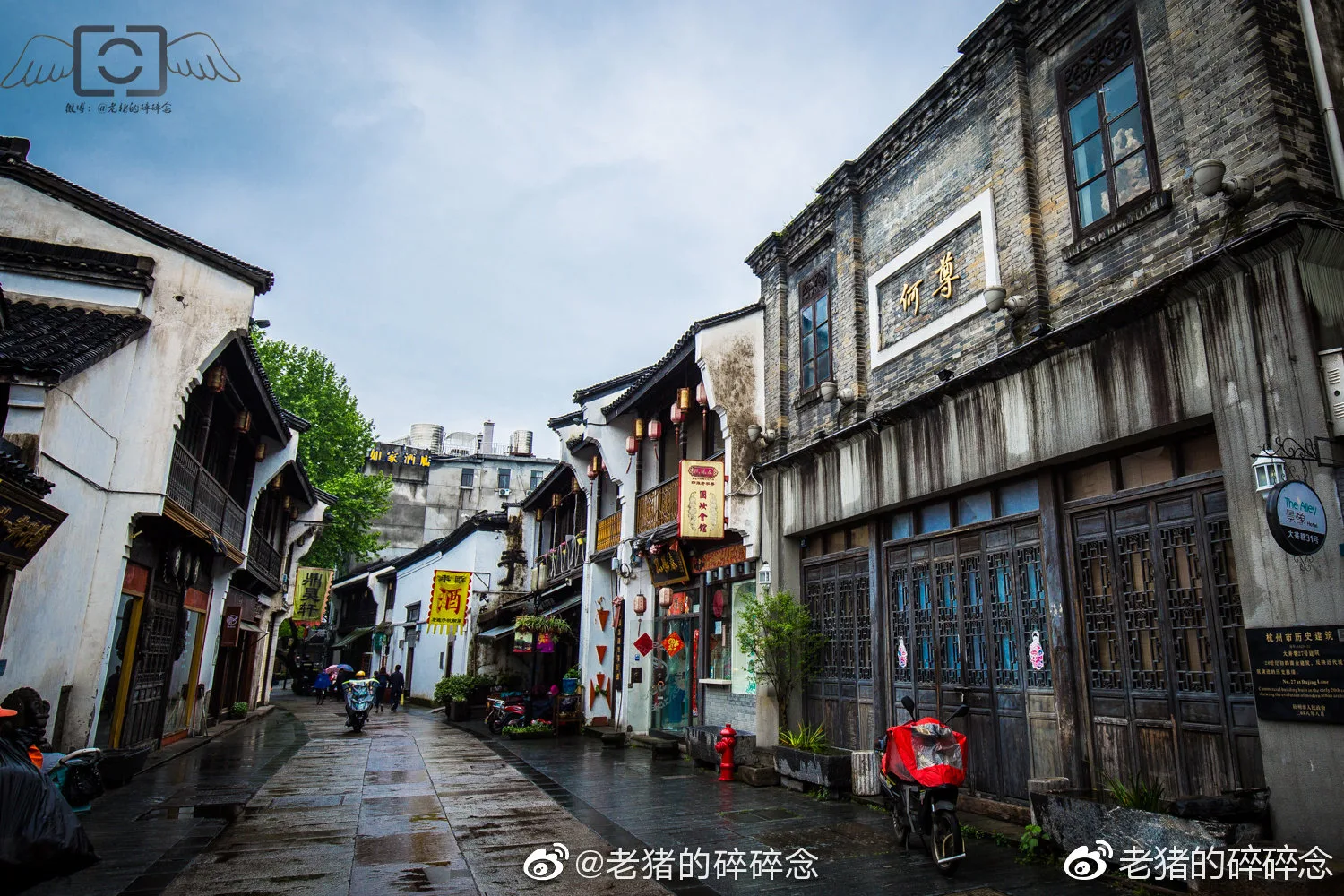
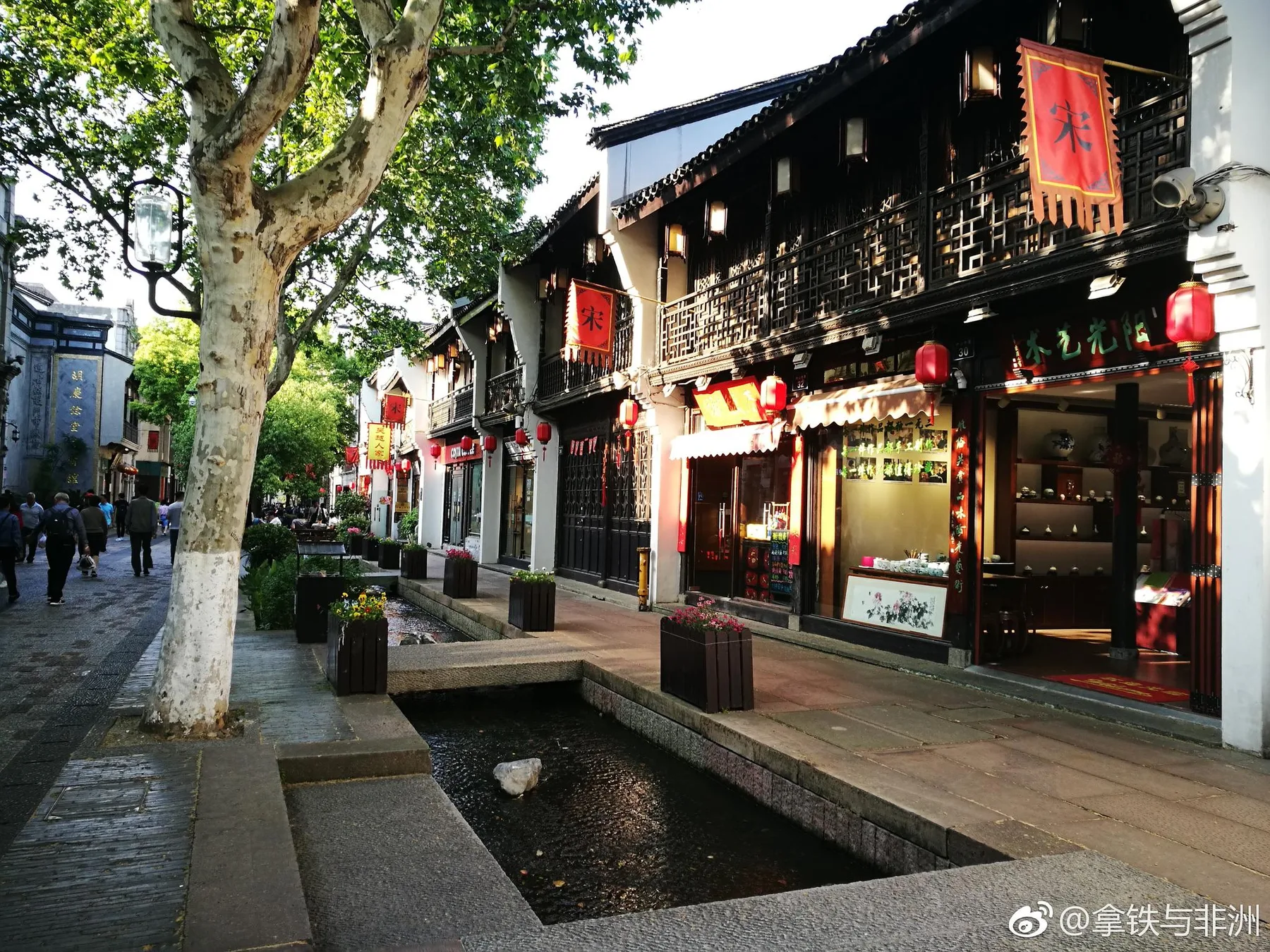
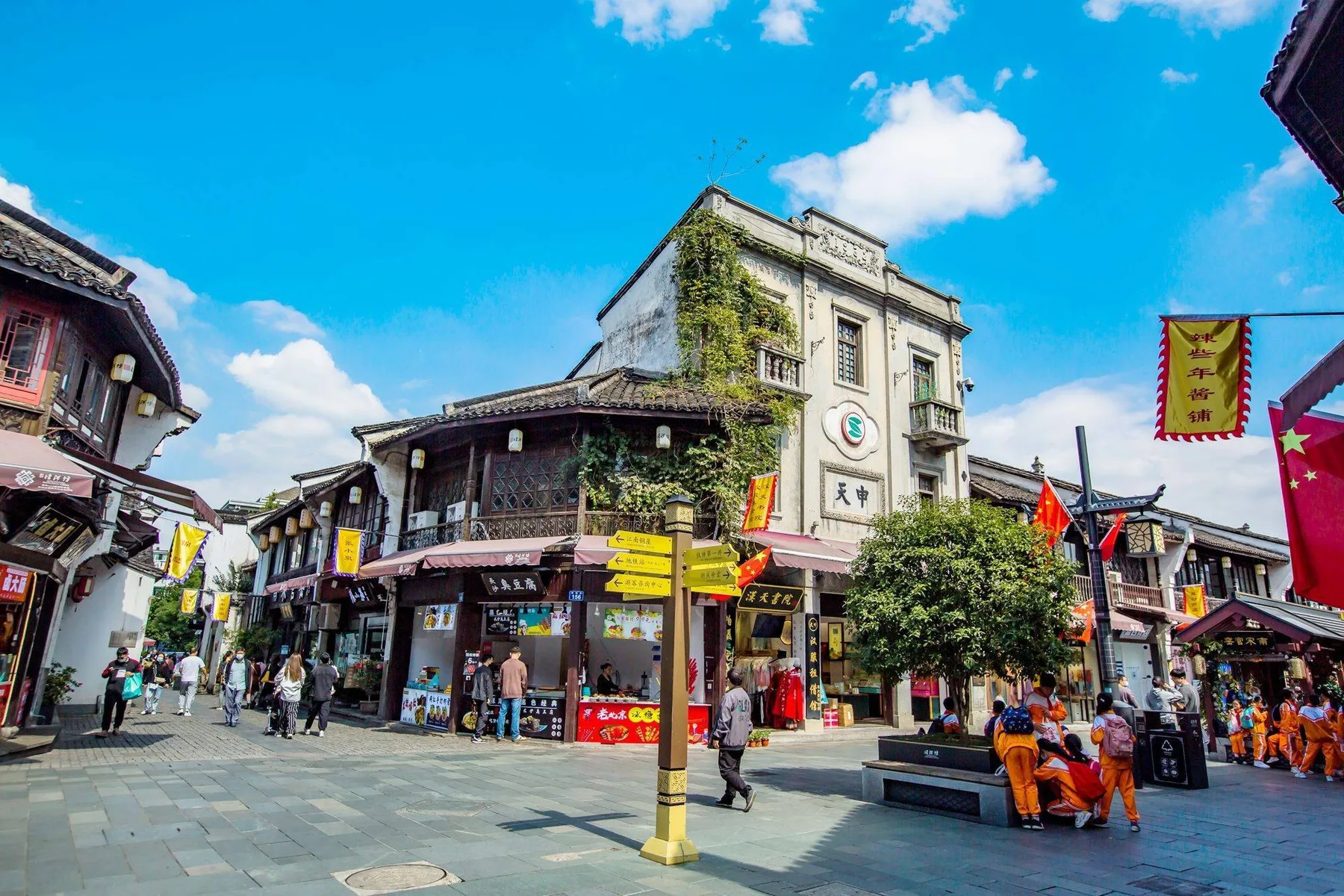
The Qinghefang historic district is the most famous old block in Hangzhou and the only one still relatively intact — a condensed version of the city's history.
Its name comes from the Southern Song grand preceptor Zhang Jun: in 1129 he repelled Jin forces at Mingzhou (today's Ningbo) in the Gaoqiao victory, and was later enfeoffed as Prince of Qinghe. He built his mansion on what is now Taiping Lane off Hefang Street, and the area took the name.
The Southern Song Imperial Street runs north–south along Middle Zhongshan Road, from West Lake Avenue in the north to Hefang Street in the south. Because it was reserved for the emperor and barred to officials and commoners, it was also called the "Forbidden Street". It existed as an official road under the Wuyue kingdom in the Five Dynasties and was extended and rebuilt in the Southern Song; in the Republican era the segments were joined and renamed Zhongshan Road after Sun Yat-sen.
Together with the imperial palace and the ancestral temple, the street was one of the three architectural symbols of the Southern Song state. Like the imperial way of the Northern Song capital, shops were allowed on both sides, and trade flourished: historical records name around 150 famous shops and their addresses, in seven broad categories — daily goods, wine houses and restaurants, cloth and clothing, stationery and books, medicine, gold and silver, and entertainment. A full conservation and regeneration programme began in January 2008, and the street reopened on 30 September 2009. It crosses Hefang Street, together forming Hangzhou's historic cultural district.
Hu Qing Yu Tang
Hu Qing Yu Tang stands at 95 Dajing Lane and has been a national priority protected site since 1988. It was founded in 1874 by the late-Qing "red-hat merchant" Hu Xueyan, known as the "King of Medicine of Jiangnan" and ranked alongside Beijing's Tongrentang.
Its pharmaceutical motto is "sincere in sourcing, refined in preparation" and its business principle "this is benevolent practice; the true price has no second". Signature preparations include Qingyu Jiuxin Wan and Biwen Dan. The building is Jiangnan courtyard style, a Qing-era shop-at-front-workshop-at-back commercial structure of over 3,000 square metres that cost 300,000 taels of silver.
It now houses a clinic of traditional medicine and the Hu Qing Yu Tang Chinese Medicine Museum, worth an hour. Republican-era advertising for the pharmacy is still visible on walls on Hefang and Nanshan roads. The Fanghui Spring Hall and other old pharmacies are in the same area.
Where to eat
Zhi Wei Guan (Hubin flagship)
"Stop your carriage at the taste, dismount at the aroma." Founded in 1913 by Sun Yizhai and Yi A'er, the flagship is at 83 Renhe Road. The 1929 West Lake Exposition made its name; it became a joint state-private operation in 1956; from 1966 to 1976 it was renamed "Dongfeng Restaurant"; in 1978 dishes such as Dongpo pork, West Lake vinegar fish, Longjing shrimp and Wushan shortcake gradually resumed their original names; and in 1985 it began serving around 20 Southern Song dishes.
Order pork and crab-roe xiaolongbao, "cat's ear" noodles, Zhiwei wontons, Dongpo pork and Hangzhou smoked fish; also Happy Doubles, crab-roe olive fish and the seafood cup.
Kui Yuan Guan (Jiefang Road flagship)
Founded in 1867, this century-old noodle house is a recognised "China Time-honoured Brand", famed across the country as the "noodle king of Jiangnan". The flagship covers over a thousand square metres, with branches on Jiefang and Wenhui roads.
It began as a Huizhou noodle shop; the owner gave exam candidates poached eggs, which earned it the name "Kuiyuan" (top scholar) — later written 奎元. After the Republic, Ningbo owners shifted the flavour towards Ningbo style, emphasising the marriage of fresh and salt. In 1945 Cai Tingkai presented the inscription "unique in the southeast", and in 1996 Jin Yong visited three times, writing "Hangzhou's Kui Yuan Guan, whose noodles crown the world". From 1942 it introduced seasonal noodles and pioneered serving toppings "over the bridge".
The noodles are hand-made by the "sitting noodle" method — pressed with a bamboo pole for chew; toppings use eel killed to order and river shrimp peeled to order. Order shrimp and crispy eel noodles and pian'er chuan.
About pian'er chuan: a Hangzhou classic and one of China's Ten Great Noodles (2013), created by Kui Yuan Guan in the Qing. It is made with alkaline noodles, pickled mustard greens, bamboo shoot slices and shredded lean pork, the greens being Jiande's traditionally hand-pressed daodu vegetable. The topping is flash-fried over high heat, then tossed with par-cooked noodles: slippery noodles, thick broth, balanced salt and umami.
Fang Laoda Mian / Juying Mian Dian
Landmark queue-worthy Hangzhou shops for pian'er chuan and "mixed noodles", cooked over fierce heat with plenty of oil for real wok breath. Order kidney mixed noodles (with crackling), tomato mixed noodles, and shrimp pian'er chuan.
Note: no authoritative encyclopaedia entry for either; check on the day.
Ambré Ciel (Michelin one star)
An artful fine-dining French restaurant at Hubin with broad West Lake skyline views. Try the chef's tasting menu with seasonal seafood and wine pairings.
Note: no authoritative encyclopaedia entry; confirm reservations and pricing through official channels.
Suggested plan
Eat noodles at 10:30, when the first toppings come out of the wok and the queue has not formed. Then walk the Southern Song Imperial Street and Qinghefang, and spend an hour at the Hu Qing Yu Tang medicine museum. Snack at Zhi Wei Guan in the afternoon, then walk to Hubin before sunset for the lake breeze and the fountain. Ambré Ciel is right there if you want French for dinner.
Practical notes
- Qinghefang and the Imperial Street are open and free; the Hu Qing Yu Tang museum is ticketed (check on site)
- ⚠️ Noodle queues: at Kui Yuan Guan (Jiefang Road) and popular mixed-noodle shops like Fang Laoda, peak time is 11:30am–1:00pm. For the freshest first-batch toppings, go between 10:30 and 11:00am
- Fountain show times follow official notices, with extra performances on holidays
- This area is extremely crowded at weekends and on holidays — visit on a weekday
Photos
Sources
- Wikipedia: Qinghefang, Southern Song Imperial Street, Hu Qing Yu Tang
- Baidu Baike: Zhi Wei Guan, Kui Yuan Guan, Pian'er chuan
- Editorial listings (no encyclopaedia source): Fang Laoda Mian / Juying Mian Dian, Ambré Ciel, Hubin musical fountain