West Lake South Line: Tea Valleys and New Jiangnan Cuisine
World Travel 编辑部 · 2026-09-10 · 15 min read
The southern stretch of West Lake is the wilder half. The Su Causeway is an artificial dyke; walk west from it and you are in the hills — the terraced tea fields of Longjing, the streams of Nine Creeks, the osmanthus woods of Manjuelong. None of these is on the lakeshore, and that is precisely why Hangzhou residents go there at weekends. Several of the city's most atmospheric restaurants hide in this valley too.
At a glance
- Area: Su Causeway and Huagang Guanyu, Longjing village, Nine Creeks (Jiuxi), Hupao, Manjuelong
- Suggested time: a full day — the spread is large, so treat it as two halves
- Best time: walk the Su Causeway early morning; Nine Creeks is best in spring and autumn; Manjuelong peaks during the autumn osmanthus season
- Getting there: bus or lake shuttle to the causeway; taxi or bus plus walking for Longjing and Nine Creeks
Su Causeway and Huagang Guanyu
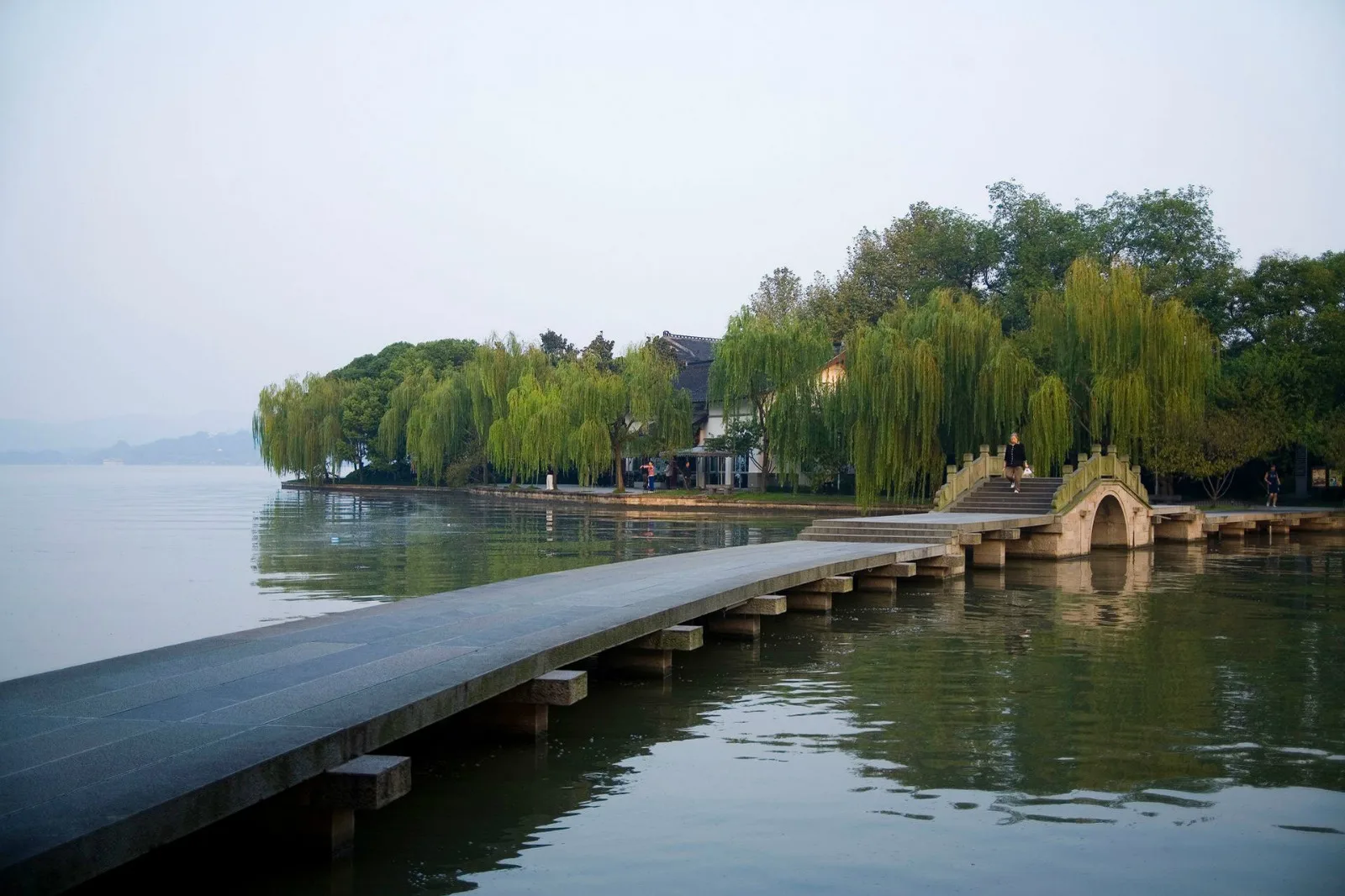
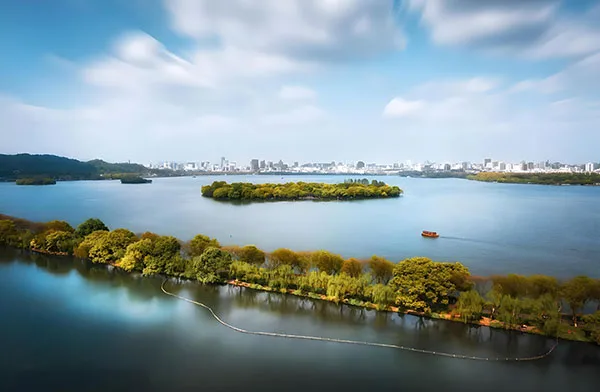
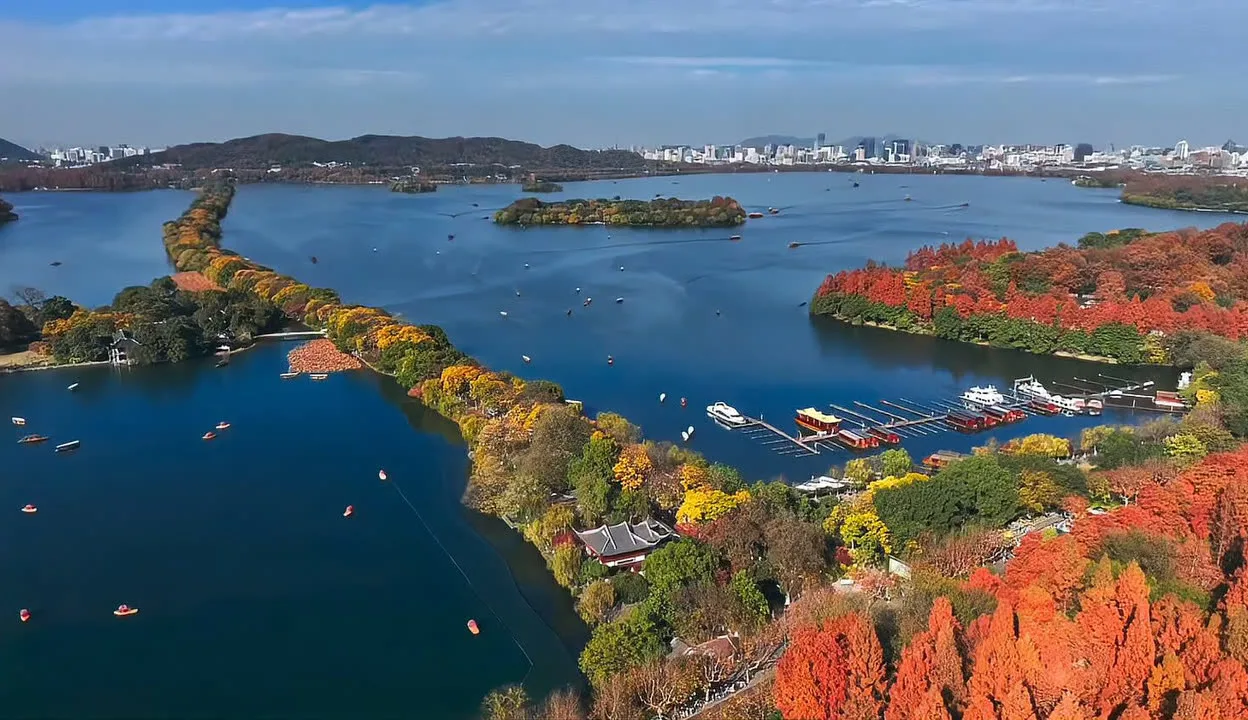
The Su Causeway runs down the western side of the lake from Huagang Guanyu at the foot of Nanping Hill in the south to Quyuan Fenghe and Yue Fei's temple at the foot of Qixia Ridge in the north — 2.797 km, dividing the Inner and Outer West Lake. With the Bai and Yang causeways it is one of the lake's three dykes.
In 1089 the prefect Su Shi dredged West Lake and used the silt and weeds to build this dyke; it was later named after him. In the Southern Song it connected the northern and southern hills, became a thoroughfare and grew into a market, and turned into the classic place for Hangzhou residents to go spring outing. Willows and peach trees were planted along it, mixed with magnolia, cherry, hibiscus and osmanthus — which is why "Spring Dawn on the Su Causeway" tops the Ten Views of West Lake.
Six bridges keep the two parts of the lake connected: Yingbo, Suolan, Wangshan, Yadi, Dongpu and Kuahong, from south to north. A local rhyme goes, "Six bridges on West Lake, a willow then a peach." The imperial "Spring Dawn on the Su Causeway" stele by the Yadi bridge carries an inscription by the Kangxi emperor dated to his 38th year.
Allow 40 minutes to an hour to walk the length.
Huagang Guanyu (Viewing Fish at Flower Harbour) is one of the Ten Views, with several thousand red carp in its pools. The Peony Pavilion at its centre is surrounded by peony beds, a traditional local spot for a day out.
A footnote on the name: in northern Wu dialect, gang means a (dead-end) stream — as in He Gang or Zijingang — not a harbour. Huagang, or Huaxi, was simply a small stream running off Huajia Hill, and originally had nothing to do with flowers.
Longjing village and Nine Creeks
Longjing village lies southwest in the West Lake scenic area, covering 18.09 hectares with about 800 residents. Ringed by mountains, sloping north-to-south in a Y shape, it holds close to 1,000 mu of high-mountain tea gardens and is the birthplace of West Lake Longjing tea — ranked first among the "Lion, Dragon, Cloud, Tiger" grades, and known as the "number one tea village". Sights include the Eight Views of Longjing, the eighteen "imperial tea" bushes, and the Hugong Temple, first built in the Northern Song.
Jiuxi Yanshu, also called Nine Creeks and Eighteen Gullies, is one of the New Ten Views. It runs from Longjing village in the north to Jiuxi village in the south, between forests and tea gardens, gathering the water of nine valleys into a 7-km stream. It is also a classic route for Zhejiang University's annual long walk.
Hiking tip: the classic route is Jiuxi Yanshu → Longjing village — a stream for company, terraced tea fields rising either side, and the best fresh-air walk in Hangzhou, especially in spring and autumn. Allow 2–3 hours and wear proper shoes.
Manjuelong sits southwest of the lake between Nanfeng and Baihe peaks, and holds "Manlong Guiyu" (Osmanthus Rain at Manlong), one of the New Ten Views. Osmanthus has been grown here since the Song, and by the Ming this was Hangzhou's densest osmanthus area: more than 7,000 trees survive — golden, silver, red and four-season varieties, the oldest around 200 years old. Shiwu Cave, Shuile Cave and Yanxia Cave are nearby. Come in autumn and the whole valley smells of osmanthus.
Where to eat
Xie Xiang Lou (Zixuan Resort, Michelin two stars)
At 1 Bapanling Road inside the Zixuan Resort, run by the Jiangnan chef Yu Bin, this is one of Hangzhou's top Chinese restaurants — a Black Pearl two-diamond venue and a Best Restaurant in China pick by Food & Wine for eight consecutive years from 2008. The cooking is creative Jiangnan, with the menu refreshed monthly. The current chef, Ren Haipeng, won a Black Pearl young chef award in 2025.
Yu Bin joined Lou Wai Lou in 1993 and helped set up Xie Xiang Lou in 2005 — a career arc that mirrors Hangzhou dining's shift from old houses to new Jiangnan cooking. Locals say, "stay at Four Seasons, eat at Zixuan."
Order plum-braised spare ribs, slow-cooked Jiangnan beef, abalone rice with black truffle, and wine-marinated crab; also look for the ham-and-wild-vegetable pomegranate parcels and braised river eel with single-clove garlic.
Booking note: during the autumn osmanthus season, reserve even further ahead than usual.
Gui Yu Shan Fang (West Lake, Michelin one star)
At 2-1 Manjuelong Road, inside the "Manlong Guiyu" scenic area. Opened in September 2009, it has 19 private rooms and three small dining rooms, set in two low buildings around a Zen garden of black bamboo and osmanthus. The cooking is creative Chinese and Zhejiang, with a separate vegetarian section.
A Black Pearl restaurant every year since 2018, it received a Michelin star and service award in May 2023. During the 2016 G20 summit it hosted Theresa May, then the UK prime minister, among other dignitaries.
Order black pork with nine-cured tangerine peel, spring-water beef, steamed cod with osmanthus chilli oil, and the vegetarian stir-fry; also Dongpo pork, West Lake vinegar fish and Hupao spring-water beef.
Long Jing Cao Tang (Michelin one star)
At 399 Longjing Road, east of the Eight Views of Longjing. A classical Jiangnan garden of some 27 mu, with water, islets and zigzag bridges forming the dining environment. The house rule is "eat only what is in season": sourcing is traceable, and the restaurant practises a purchasing system it calls "eating what the farmers eat", keeping a purchasing diary continuously since it opened in 2004.
This is a reservation-only private-room format — scholarly private-kitchen cooking focused on provenance, season and wood-fire craft. Order "She De", the unnamed duck soup, plain-cut free-range chicken, and hand-ground tofu; also the braised pork.
Tian Xiang Lou (Yan'an Road)
Founded in 1927 and once spoken of in the same breath as Lou Wai Lou. Order Dongpo pork (rich but not greasy, with a thick sauce), clear-soup fish balls, crisp fried "sounding bells", and beggar's chicken.
Note: no authoritative encyclopaedia entry could be cited; please confirm hours and booking through official channels. (Searching "Tian Xiang Lou" also returns a building of the same name in Dream of the Red Chamber — unrelated.)
Suggested plan
Start early at the south end of the Su Causeway and walk north, finishing at Huagang Guanyu. Around midday take a taxi into the hills for lunch in the Manjuelong or Longjing area (Gui Yu Shan Fang and Xie Xiang Lou are both here). In the afternoon hike Nine Creeks up to Longjing village. For dinner, book a private room at Long Jing Cao Tang, or head back into town for Tian Xiang Lou.
Practical notes
- The Su Causeway and Huagang Guanyu are free; Nine Creeks and Longjing are open areas
- Xie Xiang Lou, Gui Yu Shan Fang and Long Jing Cao Tang all require reservations — 2–4 weeks ahead for holidays and the osmanthus season
- Long Jing Cao Tang is a reservation-only private-room venue; confirm by phone or official channels
- The Nine Creeks walk is about 7 km: non-slip shoes, and mosquito repellent in summer
- Osmanthus season (usually September–October) draws heavy crowds to Manjuelong — go on a weekday
Photos
Sources
- Wikipedia: Su Causeway, Huagang Guanyu, Jiuxi Yanshu
- Baidu Baike: Longjing village, Manjuelong, Xie Xiang Lou, Gui Yu Shan Fang, Long Jing Cao Tang
- Editorial listing (no encyclopaedia source): Tian Xiang Lou