Wulin and the Grand Canal: Canal Terminus, Wetland and City Dining
World Travel 编辑部 · 2026-09-10 · 11 min read
Wulin is modern Hangzhou's downtown, and the southern terminus of the Grand Canal lies just to its north. The combination is what makes this area interesting: museum-hop through canal-side industrial remains in the morning, drift through China's first national wetland park by punt in the afternoon, and eat in a rooftop restaurant back in the city that evening. Nowhere else in Hangzhou packs so many layers into one day.
At a glance
- Area: Wulin business district (around Hangzhou Centre), the Grand Canal at Gongchen Bridge and the Qiaoxi historic block, Xixi National Wetland Park
- Suggested time: a full day — the canal is in the north and Xixi in the west, so allow travel time
- Best time: canal water buses run by day; Xixi is best in the morning or mid-afternoon
- Getting there: water bus line 1 to Gongchen Bridge; taxi or bus to Xixi
The Grand Canal (Gongchen Bridge and Qiaoxi)
The Grand Canal runs from the confluence of five rivers at Tongzhou in Beijing in the north to Hangzhou in the south, crossing four provinces and two municipalities and linking the Hai, Yellow, Huai, Yangtze and Qiantang river systems — a total of 1,794 km. In 2014 it was inscribed on the World Heritage List as part of the Grand Canal.
Its basis is the Sui-dynasty canal built after the reunification of north and south. Kublai Khan, wanting to connect the economic centre of Jiangnan with the political centre of Dadu, rebuilt it, keeping the old Hangou and Jiangnan sections while cutting a new direct route through Shandong that bypassed Luoyang. Before sea transport and modern railways, the canal carried as much as three-quarters of the country's freight.
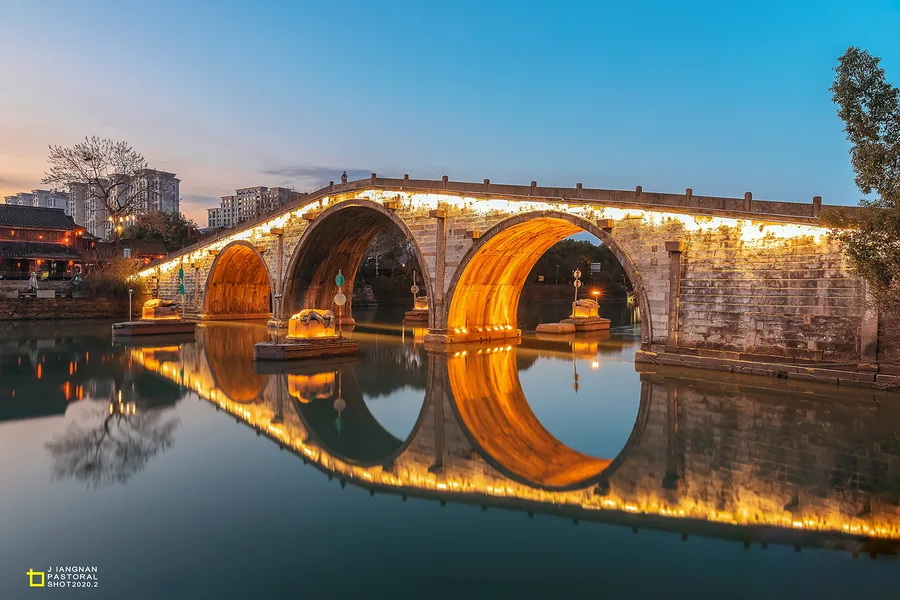
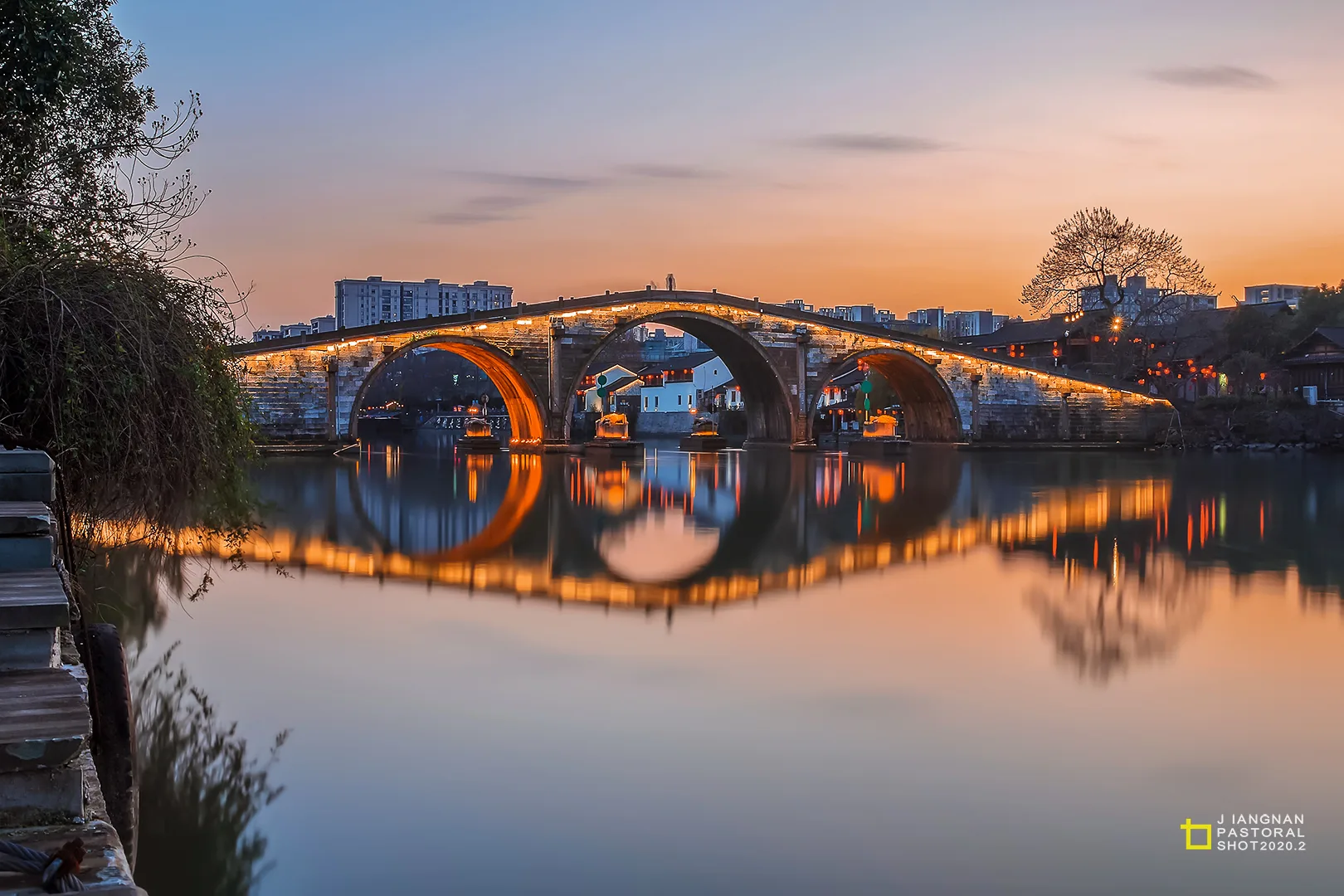
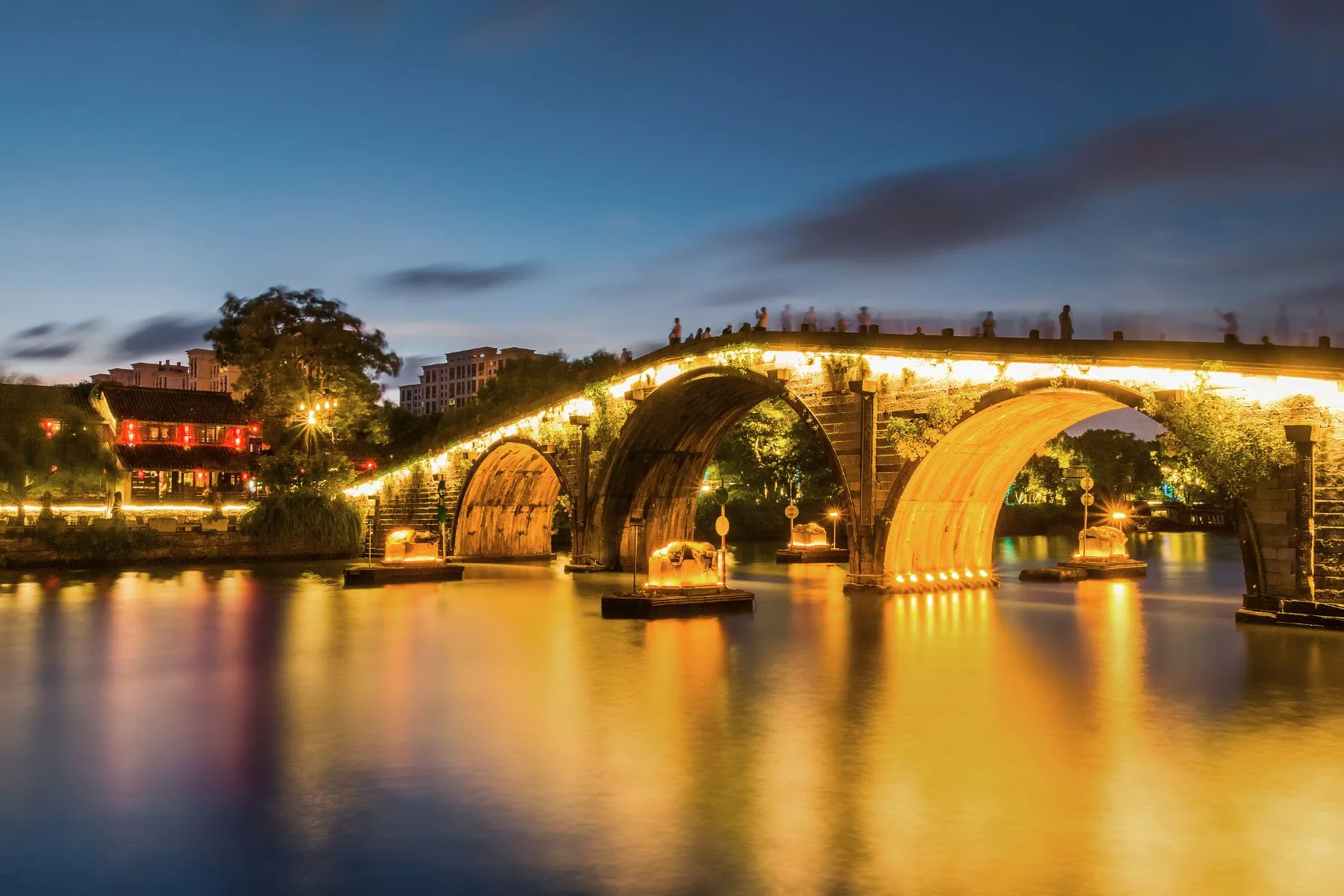
Gongchen Bridge marks the canal's southern terminus and is the largest surviving stone arch bridge in urban Hangzhou. At the northern end of Gongshu district, it links Taizhou Road and Qiaonong Street. First built in 1631 (the fourth year of the Chongzhen era) and rebuilt in 1885, it is a three-arch thin-pier bridge 92.1 metres long, 5.9 metres wide, with a central arch 9.2 metres high. The body is laid in staggered stone courses tied with long lock-stones; the deck curves gently, and plain stone balustrades are capped by pillars many of them carved with upturned lotus.
The name explains itself: chen means the imperial palace, and the tall arch symbolises greeting and reverence for the emperor.
Tip: take canal water bus line 1 to Gongchen Bridge, then walk the Qiaoxi historic block, where old industrial buildings now hold the China Umbrella Museum and the China Sword, Scissors and Sword Museum. The area preserves both the canal's grain-shipping past and its industrial one.
(For a full walking route, see our Gongchen Bridge and Qiaoxi guide.)
Xixi National Wetland Park
"Stay a while at Xixi." Straddling Xihu and Yuhang districts less than 5 km from West Lake, the park covers 11.5 square kilometres, with around 100 km of waterways and roughly 70% of the area given over to channels, ponds, lakes and marsh. With West Lake and Xiling it forms Hangzhou's "Three Xis", and it is China's first national wetland park combining urban, agricultural and cultural wetland. It was rated a national 5A scenic area in 2012.
Tip: take a punt through the winding channels, or walk the Shentankou old stage and Yanshui Fishing Village area. The park is large — do not try to cover it. Choose one water route and one walk.
(For route options, see our Xixi Wetland half-day guide.)
Where to eat
Song (Four Seasons Hotel Hangzhou Centre, Michelin one star)
A rooftop landmark in the core of Wulin, serving new-style refined Chinese cooking that blends Cantonese technique with Jiangnan flavours. Order crispy roast goose with black truffle, Chaozhou-style chilled seafood, and seasonal Jiangnan river fish.
Note: no authoritative encyclopaedia entry could be cited; confirm reservations and pricing through official channels.
Xin Rong Ji (Xixi Wetland, Michelin one star)
The benchmark Taizhou seafood brand, set among the wetland waterways, with exceptionally strict and consistent sourcing. Order braised yellow croaker, glass noodles with sand garlic, crispy squab, and crispy ribbonfish.
Xin Rong Ji was founded in October 1995 in Linhai, Taizhou, by Zhang Yong. Its first Shanghai restaurant opened in 2010 and became the group's first Michelin-starred venue in 2016; Rong Fu Yan in Shanghai earned two stars in 2018; and in 2019 its Beijing restaurant became the first Michelin three-star Chinese restaurant in mainland China. The seafood follows the season — ask what came in that day.
Lao Niang Jiu / Zhuang Yuan Guan
Long-standing, inexpensive noodle shops on the canal at Gongchen Bridge and in the old city, serving Huaiyang and Hangzhou home-style cooking. Order shrimp noodles, eel noodles and traditional braised dishes.
Note: no authoritative encyclopaedia entry for either; confirm through official channels.
Suggested plan
Take the water bus to Gongchen Bridge in the morning and work through Qiaoxi and the umbrella and knife-and-scissors museums; have a bowl of eel noodles by the canal for lunch. In the afternoon take a taxi to Xixi for a punt ride (about two hours). Return to Wulin for dinner — a rooftop table at Song, or stay out at Xin Rong Ji in Xixi and come back afterwards.
Practical notes
- Canal water buses run to a timetable; check official notices
- The Qiaoxi museums are generally free but have set opening hours — check before going
- Xixi Wetland is ticketed, with punt rides charged separately; booking ahead is advisable
- Song and Xin Rong Ji both require reservations — 2–4 weeks ahead for weekends and holidays
- The canal and Xixi are in the north and west respectively; allow 40 minutes or more between them
Photos
Sources
- Wikipedia: Grand Canal, Gongchen Bridge
- Baidu Baike: Xixi National Wetland Park, Xin Rong Ji
- Editorial listings (no encyclopaedia source): Song, Lao Niang Jiu / Zhuang Yuan Guan