Jing'an Temple: Ancient Shrine, Modern Tables
World Travel 编辑部 · 2026-09-10 · 10 min read
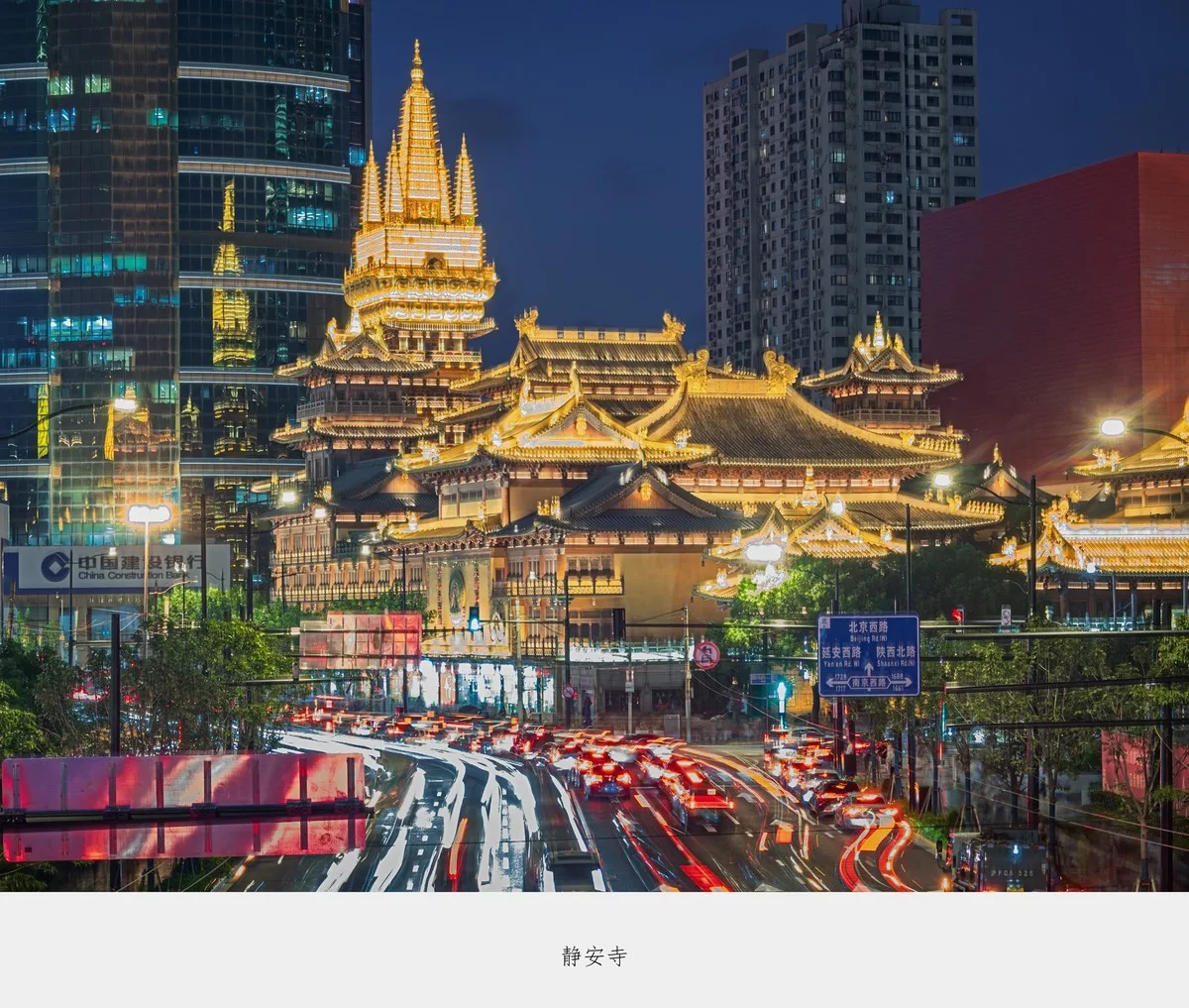
Jing'an Temple is Shanghai's strangest contrast: a temple founded in the Three Kingdoms period, ringed by glass office towers and shopping malls. Incense smoke and luxury counters face each other across West Nanjing Road, and neither gives ground. The district is compact — half a day covers it — but the density of good food is high.
At a glance
- Area : around Jing'an Temple — West Nanjing Road, Yuyuan Road, Fumin Road, Jinxian Road
- Suggested time: half a day
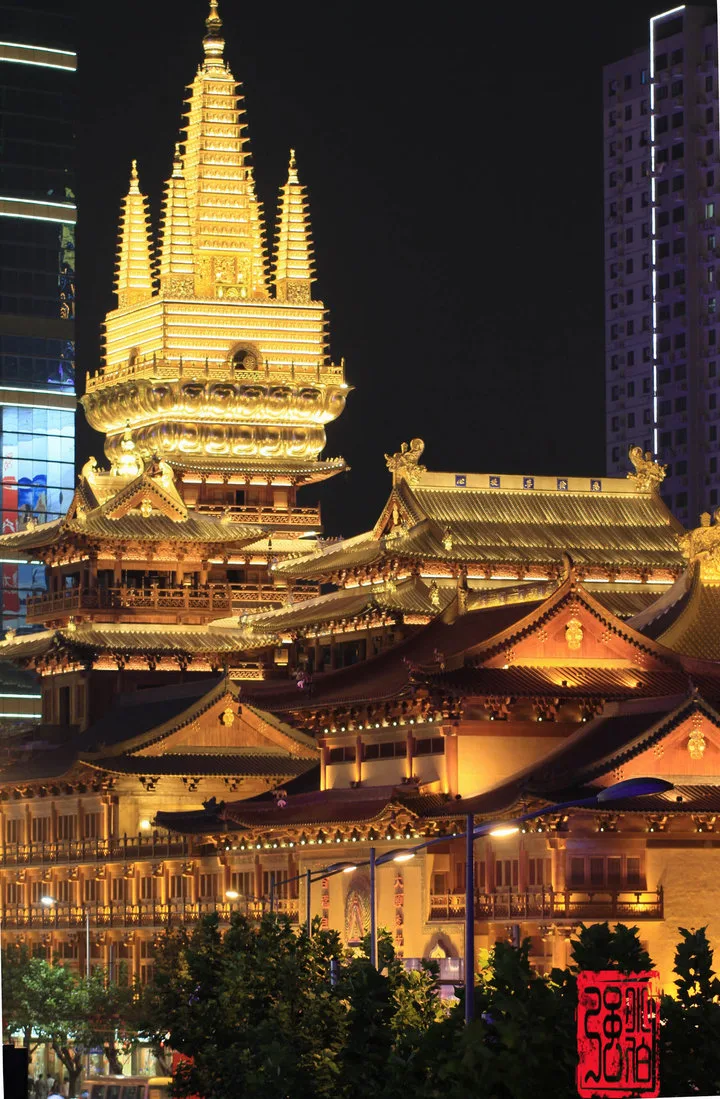
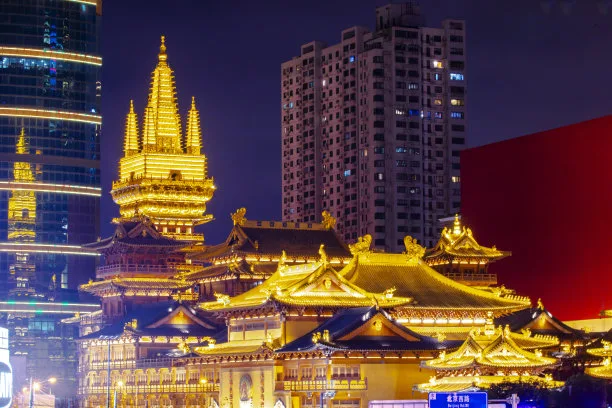
- Best time: after dark, when the temple's golden roof is floodlit
- Metro: Lines 2 / 7 / 14, Jing'an Temple
Jing'an Temple: 1,700 years old, a century of retail
The temple stands at 1686 West Nanjing Road and traces its origins to the 3rd century. According to the Chiwu stele in the temple, it was founded in 247 by the monk Kang Senghui in the tenth year of the Chiwu era of the Kingdom of Wu, and was first named Hudu Chongxuan Temple, on the north bank of the Wusong River — over 1,700 years ago. It is one of Shanghai's four great Buddhist temples. It was renamed Yongtai Chan Temple in the Tang dynasty and took its present name in 1008; in 1216 the abbot moved it to the current site because the original foundations were being eroded by the river.
The temple's Eight Jing'an Sights once included the Chiwu stele, the Chen dynasty juniper, the sermon terrace, the shrimp pond, the bubbling spring, the green-cloud cave and others; the spring before the gate was praised as the "sixth finest spring under heaven". A bronze bell cast in 1369 still survives as a temple treasure.
What turned an ancient temple into a commercial hub was the concessions. In 1862 a racecourse road was extended to Jing'an Temple, creating Jing'an Temple Road (today's West Nanjing Road); in 1899 the International Settlement expanded west to the temple, and the once-rural area rapidly became a busy commercial district. In 1908 Shanghai's first tram line opened with Jing'an Temple as its terminus. In 1953 the monk Chi Song established a Shingon altar here, making it a Vajrayana site.
It has survived two catastrophes: destroyed in 1860 when Taiping forces reached Shanghai's western outskirts, and rebuilt in 1880 with funding from Hu Xueyan and others; then, after 1966, the buildings were occupied and converted into a plastics factory, and the main hall burned down in 1972. Today's golden roof is the result of later reconstruction — floodlit at night, the whole temple glows, an extreme visual contrast with the office towers around it, and the single best thing to see here.
Where to eat
Wang Jia Sha (flagship, West Nanjing Road)
Known as the "king of Shanghai dim sum", it gathers the range of handmade Benbang snacks in one shop. Order crab-roe xiaolong, shepherd's purse wontons, "two-sided golden" fried noodles (with yellow croaker or pork), and eight-treasure rice pudding. The fried noodles are a Shanghai original — the noodle cake is pan-fried first, then topped with sauce: crisp outside, soft within.
Note: details for this shop come from local editorial listings, as no authoritative encyclopaedia entry could be cited. Please confirm opening hours through official channels.
Ji Pin Xuan (Bohua Plaza)
Refined Cantonese cooking that has held two Michelin stars, with solid technique and meticulous presentation. Order crispy chicken with shrimp mousse, crispy rice in lobster soup, and roast goose with black truffle.
Note: details come from local editorial listings; no authoritative encyclopaedia entry is available. Confirm reservations and prices through official channels.
The Benbang small-plate cluster on Fumin and Jinxian Roads
A cluster of small, unpretentious Shanghainese restaurants under the plane trees (Lan Xin, Mao Long, Hai Jin Zi and others). The appeal is not any single restaurant but the density — a dozen or more on two streets, with near-identical menus, all cooking the same Benbang repertoire.
To read those menus, know what Benbang means: Shanghai cuisine (Hu cai) is built on Benbang cooking — red braising, quick stir-frying, and dark, glossy, sweet-savoury sauces — while absorbing traditions from neighbouring Jiangsu and Zhejiang and, after the port opened, a degree of Western influence. It is summed up as rich stocks, dark glossy sauces, generous sugar and deep colour, balanced seasoning, with an emphasis on ingredients that are live, fresh, properly sized and seasonal, and seasoning that leans on salt, sweetness, wine lees and sourness. After 1843 there was a saying that "sixteen regional schools contended in Shanghai" — Benbang was only one of them.
Order with confidence: red-braised pork belly, soy-marinated duck, stir-fried shrimp, and "sizzling oil" eel shreds.
Suggested plan
Arrive in the afternoon, spend an hour at the temple, then pick up dim sum at Wang Jia Sha on West Nanjing Road. Browse the malls, and come back after dark for the lit roof. Dinner runs two ways — Ji Pin Xuan for refined Cantonese (reserve ahead), or a small Benbang restaurant on Fumin or Jinxian Road, where the places without a queue are often the better bet.
Practical notes
- The temple charges an entrance/incense fee; check on-site notices
- Reserve ahead for Ji Pin Xuan
- Fumin and Jinxian Road restaurants are small and fill up at mealtimes
- The malls connect directly to the metro, so rainy days are manageable
Photos
Sources
- Wikipedia: Jing'an Temple, Shanghai cuisine
- Editorial listings (no encyclopaedia source available): Wang Jia Sha, Ji Pin Xuan