Du Fu's Thatched Cottage: One Hut and Two Hundred and Forty Poems
World Travel 编辑部 · 2026-09-10 · 7 min read
Du Fu's Thatched Cottage: One Hut and Two Hundred and Forty Poems
Beside Huanhuaxi Park at 38 Qinghua Road in Chengdu's Qingyang district lies a 24-hectare garden: Du Fu's Thatched Cottage, also the Du Fu Thatched Cottage Museum.
759: a single thatched hut
In the winter of 759, fleeing the An Lushan rebellion, the poet Du Fu (712–770) brought his family to Chengdu. Helped by Yan Wu and others, he spent more than a year building a thatched hut by the Huanhua Stream, and lived in it for three years and nine months.
In 765 Yan Wu died and the family left Chengdu, heading east by boat. A year later the military governor Cui Ning gave the hut to his wife's family, who folded it into their estate and then donated it as a temple.
In a poem on his dwelling by the Brocade Water, Du Fu placed it as "the house west of Wanli Bridge, the farm north of Baihua Pool". The modern scholar Feng Zhi wrote in his Life of Du Fu: "When people speak of Du Fu they can forget where he was born and where he died, but they never forget the Chengdu cottage."
In roughly four years there Du Fu wrote more than 240 poems, among them "My Thatched Hut Was Torn Apart by Autumn Winds", "Happy Rain on a Spring Night", "The Prime Minister of Shu" and "For a Guest".
Fourteen rebuildings, and the Hall of Elegance
Late in the Tang the poet Wei Zhuang found the site and rebuilt the hut. Since then the cottage has seen fourteen major repairs and expansions through Song, Yuan, Ming and Qing. The two largest, in 1500 and 1811, fixed essentially today's scale and layout.
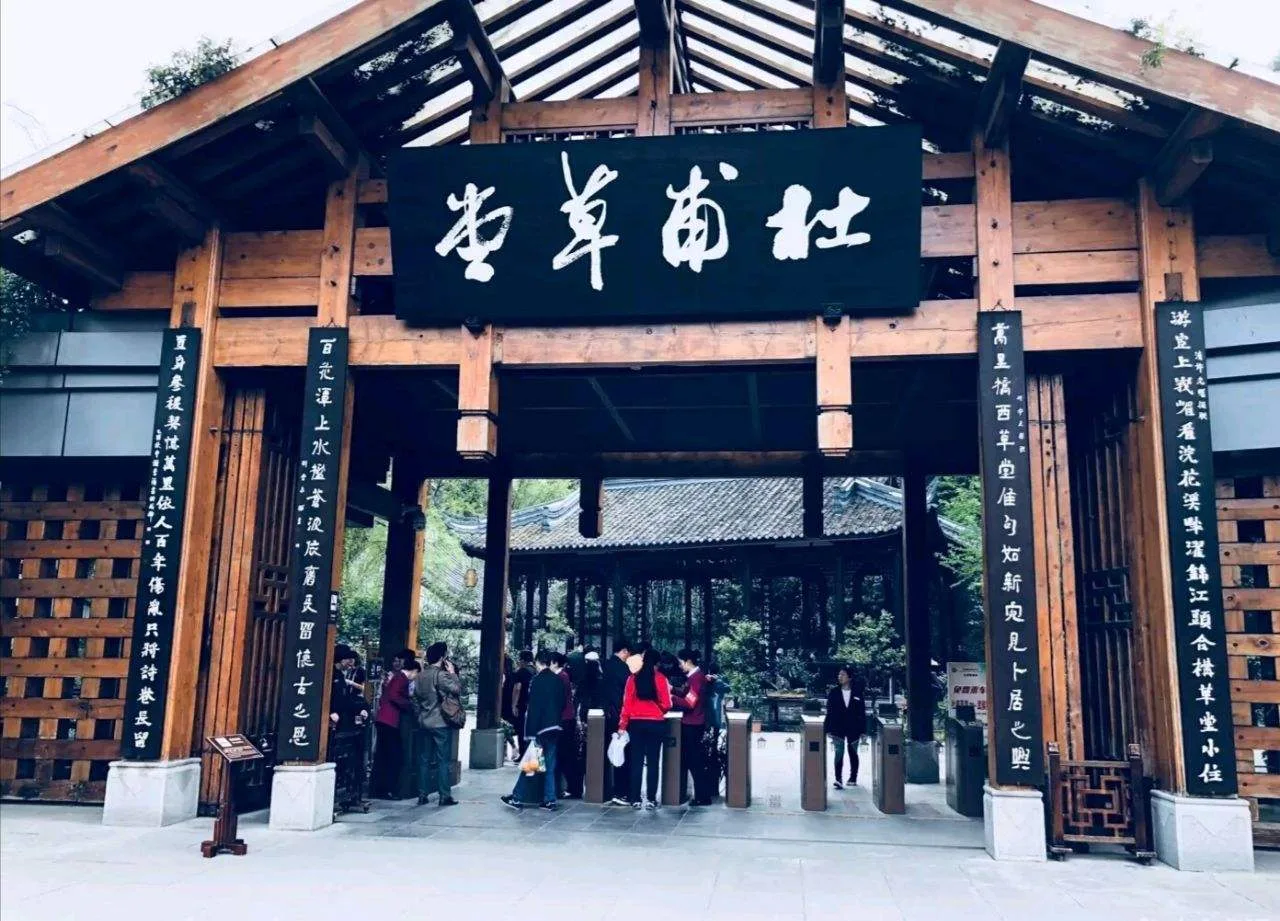
Most of the present buildings date from those two campaigns. The gate plaque carries the four characters "Du Fu Thatched Cottage" in Guo Moruo's hand. The grounds hold the Hall of Elegance, the Hall of Poetry, the Brushwood Gate, the Works Ministry Shrine and the Shaoling Cottage Stele Pavilion:
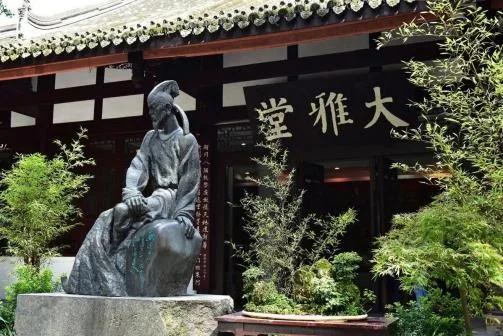
- The Hall of Elegance shows large murals of "My Thatched Hut Was Torn Apart by Autumn Winds" and "Song of the War Chariots", with statues of twelve poets — Qu Yuan, Tao Yuanming, Li Bai, Wang Wei, Su Shi, Li Qingzhao, Lu You and others
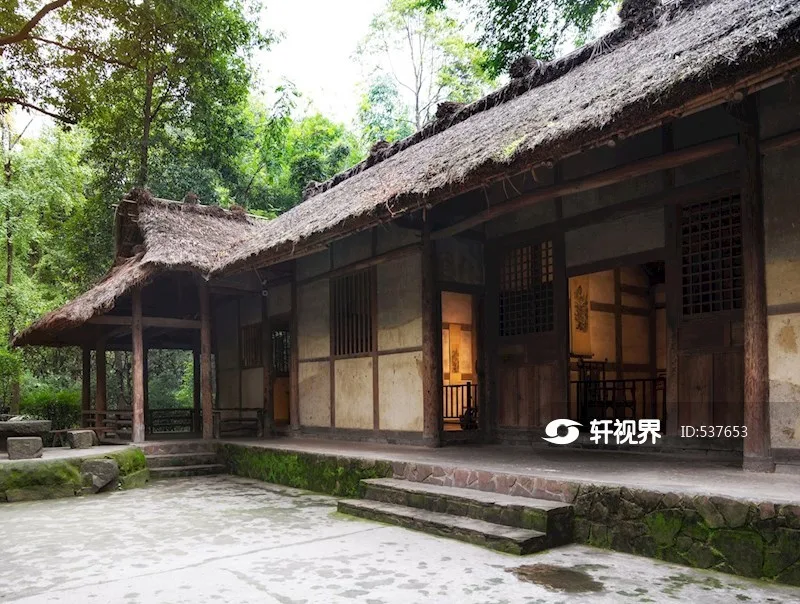
- The Brushwood Gate area holds a five-bay thatched cottage rebuilt in 1997, furnished as in Du Fu's day, down to a desk set with the four treasures of the study
- The Works Ministry Shrine displays woodblock and letterpress editions of Du Fu from the Song onward, and translations into many languages
The Tang dynasty underfoot
At the end of 2001, excavation in the northeast corner uncovered extensive Tang pavilion platforms, domestic remains and a group of Tang relics, confirming Du Fu's own description of the place. The museum built a Tang site exhibition hall over the original ground.
On 4 March 1961 the cottage was named a Major Historical and Cultural Site Protected at the National Level (first batch); in December 2006 it became a national AAAA scenic area; in May 2008, among the first batch of national first-grade museums.
Practical
- Route: gate → Hall of Elegance → Hall of Poetry → Brushwood Gate (the cottage) → Works Ministry Shrine → Shaoling Cottage Stele Pavilion
- Key stop: the rebuilt cottage at the Brushwood Gate, the place that best answers the poems
- One more: the Tang site hall in the northeast corner, on the ground where it was found in 2001
- Nearby: Huanhuaxi Park next door, easy to fold in
- Tickets and hours: check the museum's notice for the day
Related
- Wuhou Shrine: China's Only Temple to Ruler and Minister Together
- Jinsha Site Museum: The Golden Sun Bird of Ancient Shu
Photos
Sources
- Wikipedia: Du Fu Thatched Cottage