Dujiangyan: A Warring-States Irrigation System Still Running
World Travel 编辑部 · 2026-09-10 · 8 min read
Dujiangyan: A Warring-States Irrigation System Still Running
An hour northwest of Chengdu, in the west of Dujiangyan city, the Min River is split in two by a piece of engineering built more than two thousand years ago. This is Dujiangyan — a large, dam-free water-diversion system begun in the Warring States period and still at work today. It is the oldest surviving example of its kind in the world, and the only one of its scale built without a dam.
Three works: the fish mouth, the spillway, the bottleneck
The headworks are made of three parts, each with one job:
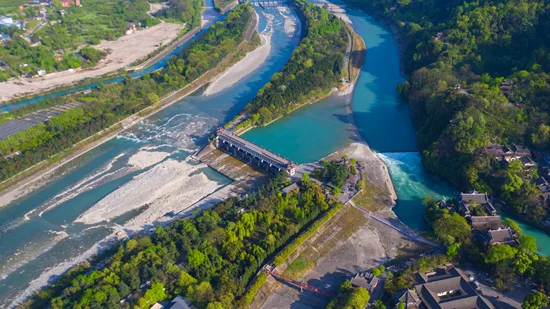
- Yuzui (Fish Mouth) — division. Sitting mid-river and shaped like a fish's snout, it cuts the Min into an outer and an inner channel. The outer channel, the Jinma River, is the Min's main course and carries floodwater; the inner one is the artificial head canal for irrigation. The current fish mouth is a half-moon of mortared stone and concrete, 80 m long, 39.1 m at its widest, 6.6 m high.
- Feishayan (Flying Sand Weir) — flood release and sand flushing. Originally called the Shilang Weir and built in the Tang dynasty (661–663), it is a gap in the lower Jintang levee, 240 m wide, its crest just 2 m above the riverbed. It follows the principle of "low crest": surplus water, sand and all, spills over into the outer channel.
- Baopingkou (Bottle-Neck Channel) — intake. A gap cut by hand through the cliff where Yulei Mountain meets the Min. Narrower at the bottom than the top — 14.3 m wide at the base, 28.9 m at the crest, 18.8 m high, 36 m long — it is shaped like a bottle neck and is the key to controlling how much water enters the inner channel.
"Four-six split, level floods and droughts"
The fish mouth sets the ratio between the two channels, using the shape of the ground rather than a gate. The inner intake is 60–150 m wide, the outer 200–300 m.
- In spring, when the river is low, four parts flow to the outer channel and six to the inner, securing water for planting.
- In the flood season, the level rises over the fish mouth and six parts rush to the outer channel, four to the inner, sparing the farmland.
That is the "four-six split" — no dam blocking the river, just the current guided so wet and dry years even out.
On the left bank at Baopingkou, dozens of notches are cut into the rock, one chi apart. Called the shui ze, or water rule, this is China's earliest water-level gauge. Under the Song it had ten notches; by the Qing, sixteen meant a major flood. Today the marks run to twenty-four.
Annual repair: a two-thousand-year maintenance regime
What keeps Dujiangyan alive is its management. Zhuge Liang posted a weir officer in the Three Kingdoms period, and by the Song dynasty a system of annual repair was fixed that survives today: each winter and spring, in the dry, idle season, the river is cut off for "dredging and repair" — the weir rebuilt, the channel dug deep. Dredging depth was measured against a stone horse buried in the riverbed, later replaced by iron bars; three survive, cast in the Wanli era, the Tongzhi era and 1927.
A route through it
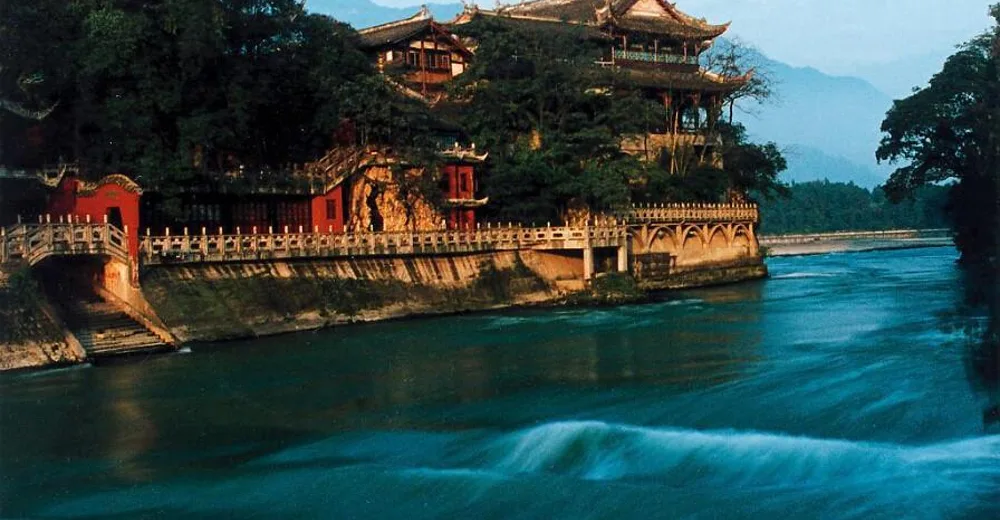
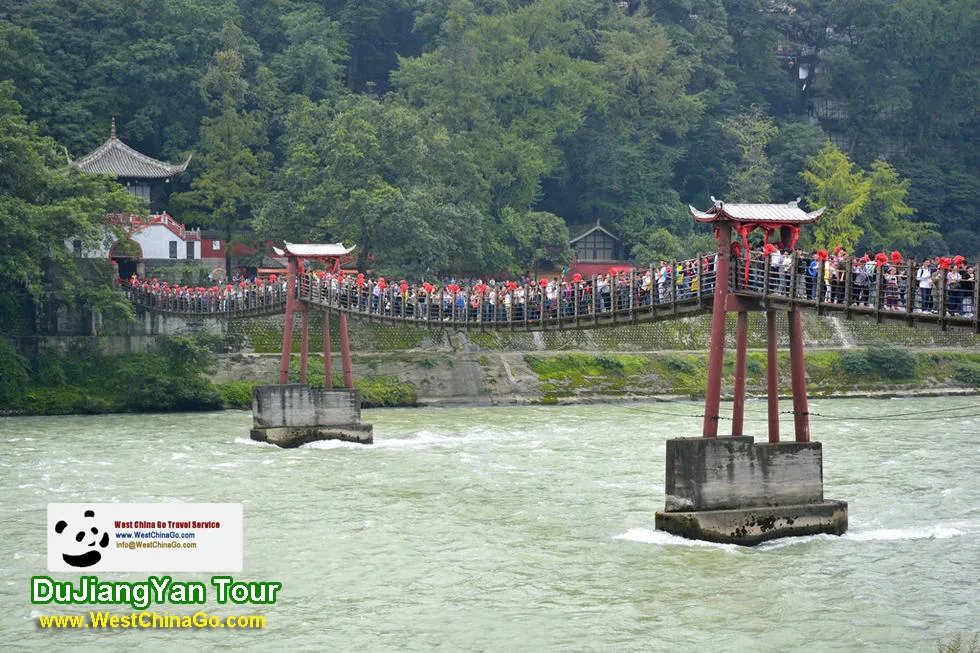
Start at the fish mouth to see the split, walk down the Jintang levee (650 m inner, 900 m outer) to the Flying Sand Weir, and finish at the Bottle-Neck Channel and Lidui, the detached hill that holds the Fulong Guan temple to Li Bing. Nearby are the Erwang Temple, the Anlan suspension bridge and Yulei Pass.
Practical
- Tickets and hours: check the site's notice for the day
- Order of visits: fish mouth → Flying Sand Weir → Bottle-Neck, to follow divide-flush-control
- Look for the gauge: on the left bank at the Bottle-Neck, the carved water rule is easy to miss
- In the wet season: the spillway is most dramatic — the best time to understand the "low crest"
- Pair it with: Mount Qingcheng, listed as a World Heritage site alongside Dujiangyan
Related
- Mount Qingcheng: Cradle of Daoism and "the Most Secluded Under Heaven"
- Jinsha Site Museum: The Golden Sun Bird of Ancient Shu
Photos
Sources
- Wikipedia: Dujiangyan