Sichuan Opera and Face-Changing: Five Tunes Under One Roof
World Travel 编辑部 · 2026-09-10 · 10 min read
Sichuan Opera and Face-Changing: Five Tunes Under One Roof
One roll of the drum and the hall knows this is Sichuan. Sichuan opera, also called Chuan opera, is one of the theatre forms of south-western China. It took shape in the Qianlong era of the mid-Qing and is performed across Sichuan and Chongqing, and in parts of Yunnan, Guizhou and Hubei. Its famous trick is face-changing; its real foundation is five vocal styles in one.
Five tunes, one stage
Sichuan opera uses five vocal styles — high-pitched, Kun, huqin, plucked and lantern. What sets it apart from other regional forms is its exceptionally high-pitched singing. On 20 May 2006 it was entered on the first national list of intangible cultural heritage, among the first 518 items.
From "Shu technique supreme" to the Sanqing Society
The lineage is long. Its origins reach back to the pre-Qin period and earlier, with Han-era acrobatics and variety shows laying the groundwork; "Song of the Rustic Poor" in a Warring States text refers to Sichuan folk performance. Records such as the Taiping Guangji and the Baishi Huibian describe a "Bullfight" play from the time of Li Bing, governor of Shu, and the Three Kingdoms period produced Sichuan's first satirical comedy. Through the Tang and Five Dynasties Sichuan theatre was at its height — "Shu technique supreme under heaven" — and produced the earliest known troupe in Chinese theatre history.
In the late Ming and early Qing, Sichuan's population collapsed and migrants moved in from across the country — the "Huguang fills Sichuan" movement. They brought their own theatre with them, and over time, built on the Sichuan lantern play and fusing high-pitched, Kun, huqin and plucked styles with Sichuan dialect, custom, folk music and dance, Sichuan opera came into being.
After the 1911 revolution, troupes known for high-pitched singing joined with those specialising in Kun, plucked and huqin styles to form the Sanqing Society, melting the five vocal styles into one repertoire and staging contemporary pieces about Qiu Jin, the Wuchang uprising and the Empress Dowager. The society pushed the form from street performance toward the proscenium, and made Sichuan opera the most influential regional theatre in the south-west. In 1952 a Sichuan delegation took a large programme to the first national festival of regional opera in Beijing, winning awards with works including "The Tale of the Willow Shade" and "Autumn on the River".
Face-changing and make-up
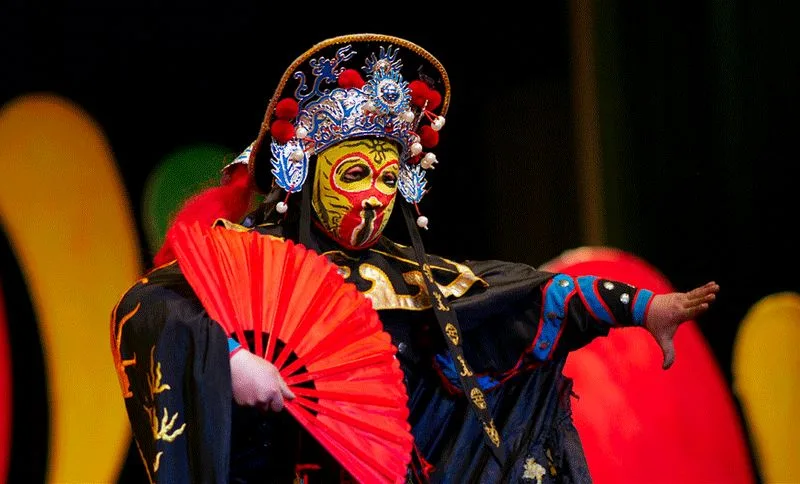
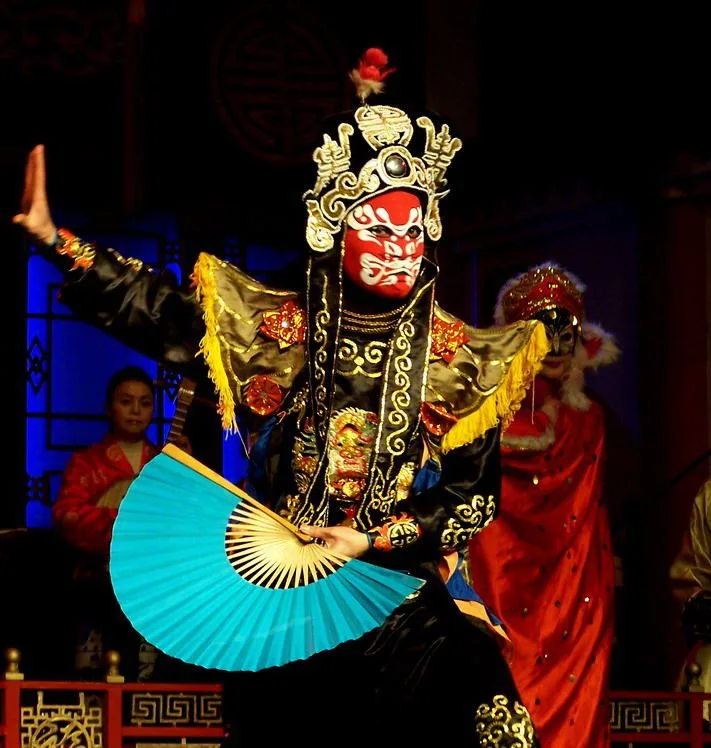
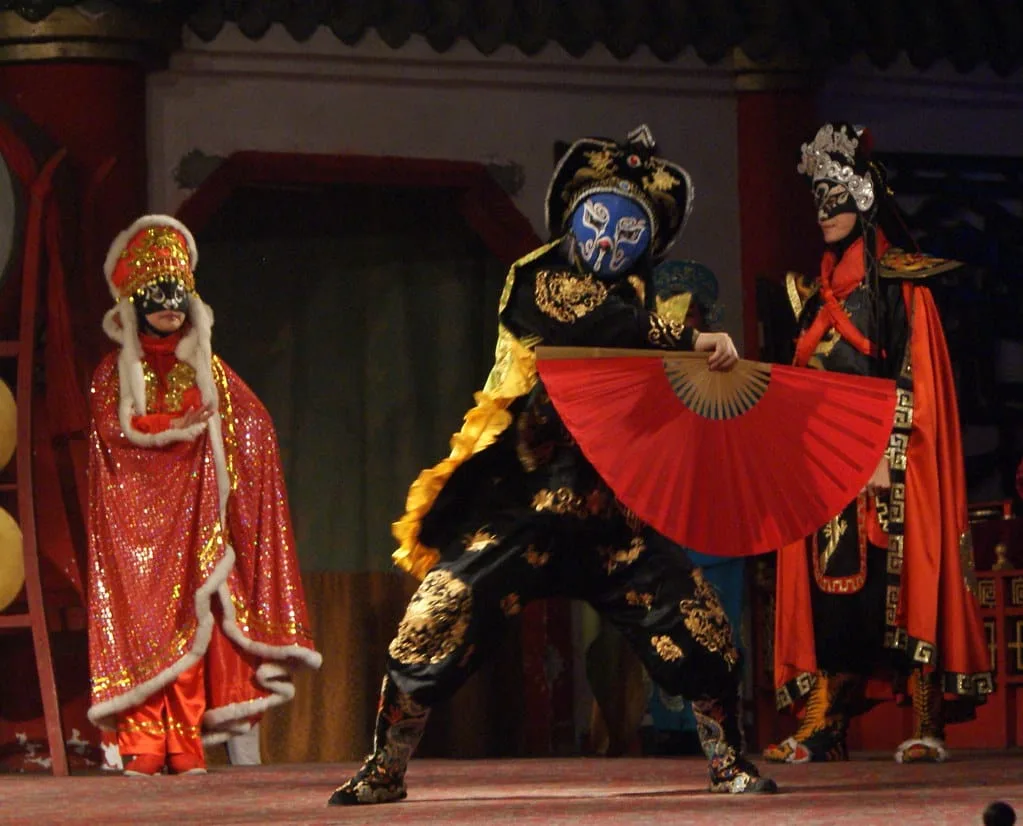
Face-changing is the best-known trick. In make-up, Sichuan opera is no less refined than Beijing opera: both the painted-face and clown roles wear masks. The clown paints a white square on the bridge of the nose — "a painted nose bridge" — turning gravity into comedy. The painted-face role, or "flower face", has a rich vocabulary of colour and clear moral coding: black for integrity, white for treachery, red for loyalty and courage, green for chivalry, blue for resolve, yellow for cruelty, and gold or silver for the sacred.
Roles fall into six categories: sheng, dan, jing, mo, chou and za. Costume includes robes, armour, official dress and everyday tunics.
Drums and the chorus
High-pitched singing is the most distinctive style: free in melody and unaccompanied, kept in time by a clapper and drum, with a striking, soaring line and a chorus answering it. The chorus sets the key, describes a scene, builds atmosphere, reveals a character's feelings and stands in for the audience's judgement.
Percussion carries unusual weight. A small drum, hall drum, large gong, large cymbal and small gong make up the "five directions"; adding strings and suona gives the "six directions", led by the small drum. There are around three hundred percussion tunes, and they can imitate oars on water, running streams, rapids, wind and rain.
Four rivers
Because the vocal styles flourished in different areas, four regional schools emerged — the "four river courses":
- West Sichuan: centred on Chengdu, strong in high-pitched and lantern styles, with its own "plain" melody
- Ziyang River: Zigong and Neijiang, mainly high-pitched and the strictest in style
- North Sichuan: Nanchong plus parts of Mianyang and Guangyuan, mainly plucked style with strong Qin influence
- East Sichuan: centred on Chongqing, mainly huqin, with more from Han and Beijing opera
Practical notes
- Also called: Chuan opera
- Formed: Qianlong era of the mid-Qing; performed in Sichuan, Chongqing and parts of Yunnan, Guizhou and Hubei
- Five styles: high-pitched, Kun, huqin, plucked, lantern
- Roles: sheng, dan, jing, mo, chou, za
- Heritage: first national intangible-heritage list, 20 May 2006
- Signature trick: face-changing
- Percussion: "five directions", or "six" with strings and suona; about three hundred percussion tunes
Related
- Wuhou Shrine: China's Only Temple to Ruler and Minister Together
- Du Fu's Thatched Cottage: One Hut and Two Hundred and Forty Poems
Photos
Sources
- Wikipedia: Sichuan opera