Jinji Lake and the Industrial Park: The Modern Suzhou Table
World Travel 编辑部 · 2026-09-10 · 13 min read
Suzhou's old city is 2,500 years old - white walls, tiled roofs, narrow canals. But if you only see the old city, you have seen half of Suzhou.
East of it, across the Gusu district, lies the Suzhou Industrial Park - formally the China-Singapore Suzhou Industrial Park. It is an intergovernmental cooperation project between China and Singapore: in September 1992 Lee Kuan Yew, then Senior Minister of Singapore, led a delegation to China to propose a joint park drawing on Singapore's experience, and after repeated negotiations and site visits the eastern side of Suzhou was chosen. The park sits east of the old city, bordering Kunshan to the east, Gusu district to the west, Wuzhong district to the south and Yangcheng Lake to the north, covering 278 square kilometres.
At its centre is a lake.
What to see
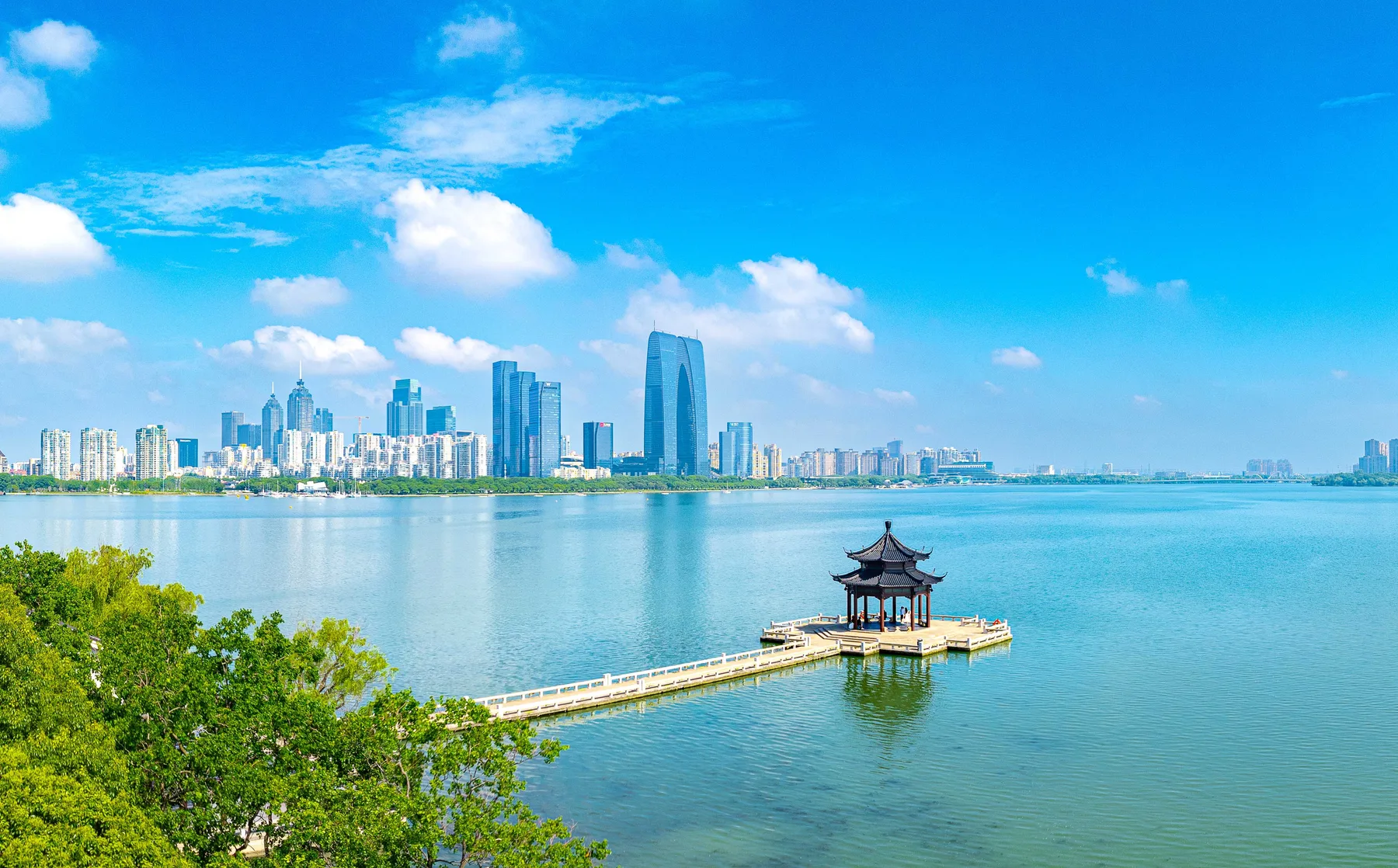
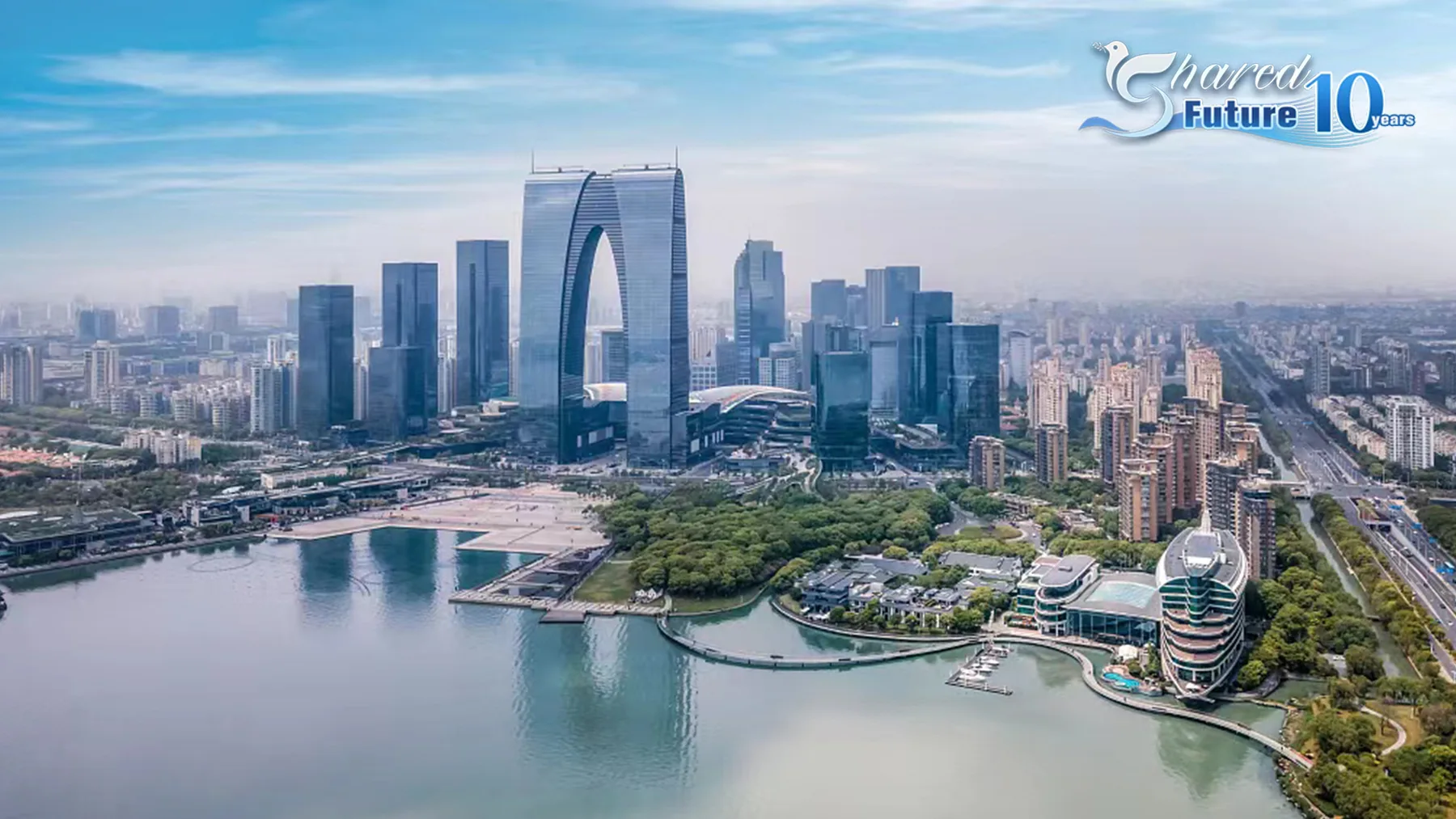
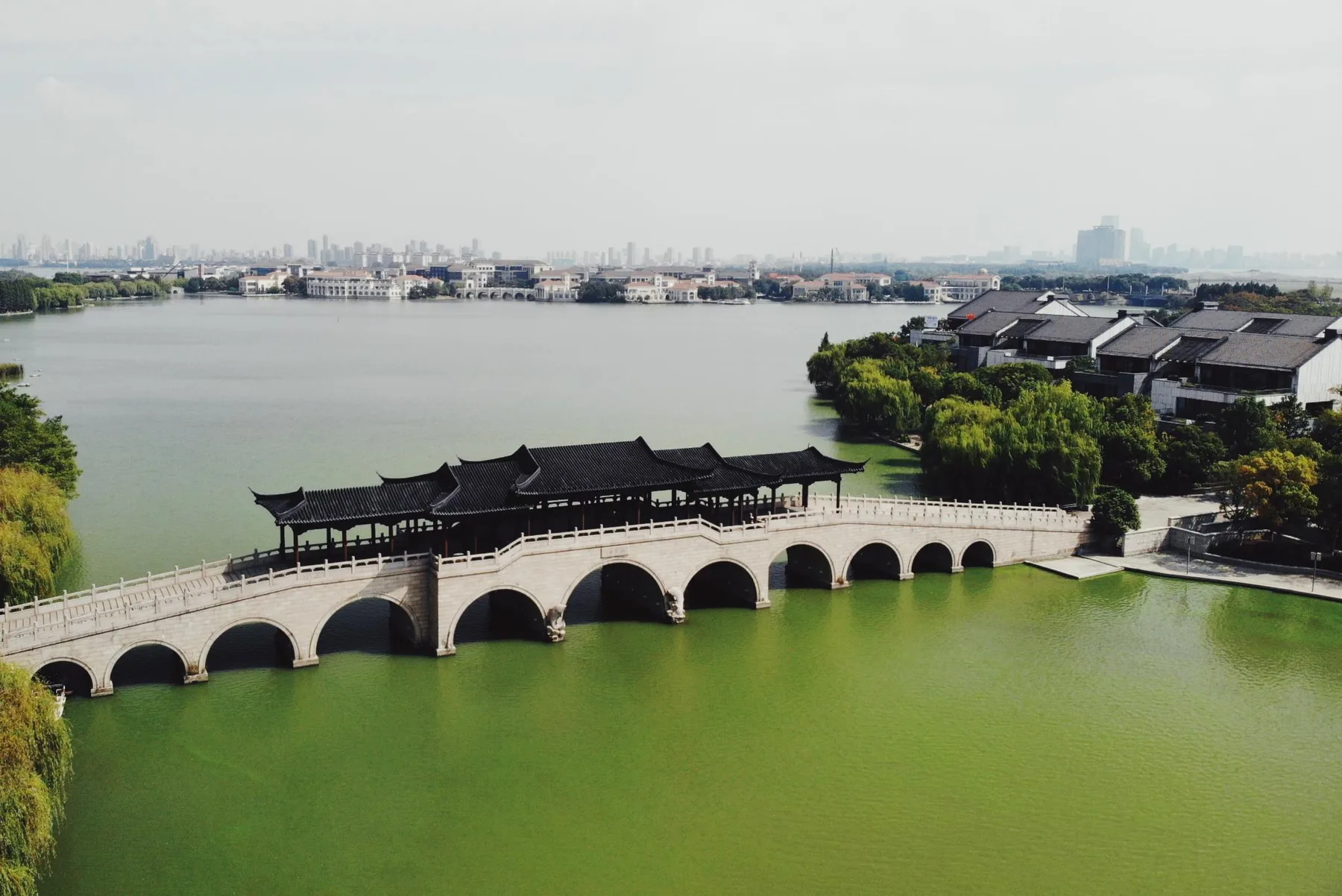
Jinji Lake is one of China's largest inner-city lakes. The water covers 10,768 mu, with an average depth of 2.5 to 3 metres - a shallow lake, connected to the surrounding water system by channels, with two artificial islands in the middle. The Jinji Lake Bridge crosses to the north; a tunnel is planned to the south.
The lakeside landmarks include the Suzhou Culture and Arts Centre, the Suzhou International Expo Centre and the Suzhou Ferris Wheel park. The shores also hold three world-class supertall towers, built or under construction: the Gate of the Orient, the Suzhou International Finance Square, and the Suzhou Zhongnan Centre, still rising. Stand at the water and look east, and you get a skyline nothing like the old city's.
At the southern end of the lake is Li Gong Causeway (Li Gong Di), a restaurant and leisure strip inside the park - the point where the lake view and the dinner table meet, and one of the default choices for an evening meal in the park.
Where to eat
The defining feature of the table out here is that it does everything well, because the park holds a large population from elsewhere.
Huachi 88, in the Hyatt Regency Suzhou, is in the Michelin Guide. Its menu joins Jiangnan and Cantonese approaches: traditional fruitwood-roast duck, cooked over open fruitwood fire for a crisp, fragrant skin; Taihu three-white soup, built on the lake's whitefish, white shrimp and silver fish, bringing the cooking back to local water; hand-peeled shrimp stir-fried plain, a test of picking; and sizzling eel in hot oil, one of the classic Suzhou flavour profiles. In a hotel kitchen in the new town, those four dishes act as a coordinate, joining new Suzhou back to old.
Huachi 88 has no public encyclopaedia entry. Dish information above is editorial; address, hours and menu should be confirmed with the Hyatt, and Michelin ratings with the Michelin Guide.
For something more everyday, the lakeside restaurant strip along Li Gong Causeway and the local and chain outlets around the lake cover everything from Suzhou noodles onwards.
If you have time: connecting to the old city
The park alone can make Suzhou feel too new. The sensible arrangement is old city in the morning, lake in the evening.
On the old-city side, the pairing not to miss is Tiger Hill and Shantang Street. Tiger Hill is credited in Suzhou as "the finest sight in Wu", and Su Dongpo is supposed to have said that to visit Suzhou without visiting Tiger Hill is a matter for regret. Its Yunyan Temple Pagoda, built in the Later Zhou, is called "China's first leaning pagoda"; the Sword Pond may hold the tomb of King Helü of Wu, and is also the setting of the legend in which Wang Xizhi traded a goose for calligraphy. Tiger Hill is today a national 5A-level scenic area.
Coming down from Tiger Hill, you land on Shantang Street: a pedestrian street with nearly 1,200 years of history, running 3,829.6 metres from Xichang Lane at the foot of Tiger Hill in the west to Duxeng Bridge on the old canal outside Changmen in the east. In 825 (the second year of the Baoli reign of the Tang), the poet Bai Juyi was transferred from Hangzhou to serve as prefect of Suzhou and, to improve water and land transport, cut the Shantang canal from Tiger Hill east to Changmen, building a road along its north bank. At about seven li long it became known as "Seven-Li Shantang", and has been called Suzhou's finest street since. On his southern tour in 1762 the Qianlong emperor wrote the characters "Shantang Xunsheng" - seeking the views of Shantang - and the stele pavilion for that inscription still stands.
The Lingering Garden deserves half a day of its own. It lies outside Changmen in the north-west of the old city and was begun in 1593 (the 21st year of the Wanli reign) by Xu Taishi, a former vice minister of the Court of Imperial Sacrifices, who brought in the rockery master Zhou Shichen; it was then called the East Garden. In 1798 Liu Shu rebuilt it on the derelict site and named it Hanbi Zhuang after its "bamboo of clear cold, water of pure blue", though because the owner was named Liu it was also known as Liu Yuan. In 1873 Sheng Kang - father of the industrialist Sheng Xuanhuai - bought it and spent three years on a large rebuilding, completed in 1876, when the homophone of the old name gave the garden its present name, Liuyuan, "the lingering garden". It is known for varied architecture and many rocks, covers about 30,000 square metres (50 mu), and is divided into a central, eastern, western and northern part, with a covered walkway 700 metres long whose walls hold more than 300 engraved steles, the "Liuyuan Model Calligraphy". It was named a national key cultural relic in 1961, a World Heritage site in 1997, and stands with the Summer Palace in Beijing, the Chengde Mountain Resort and the Humble Administrator's Garden as one of China's four classical gardens.
How to plan it
- Morning: walk Shantang Street (nearly 4 km; a boat is an option), or give half a day to Tiger Hill
- Afternoon: move to the park, walk a stretch of Jinji Lake, look at the Gate of the Orient and the lake's eastern skyline
- Evening: dinner on Li Gong Causeway, or book the Hyatt's Huachi 88
- Night: the commercial district east of the lake, for the lights
The park is directly connected to the old city by metro, 30 to 40 minutes across, so "old city plus lake" in one day is not a stretch.
Practical
- Numbers: Jinji Lake covers 10,768 mu at 2.5-3 m deep; the park covers 278 sq km
- Lakeside towers: Gate of the Orient and Suzhou International Finance Square built; Suzhou Zhongnan Centre under construction
- Hyatt Regency Suzhou: in the Industrial Park; confirm address and bookings with Hyatt
- Best time: late afternoon into evening, when the water and the lighting are both working
- Note: the park and the old city are stylistically worlds apart - either split them across two days, or take them morning and evening on one
Related
Photos
Sources
- Wikipedia: Jinji Lake, Suzhou Industrial Park, Tiger Hill, Shantang Street
- Public materials: Huachi 88 at Hyatt Regency Suzhou