Suzhou Noodles and Dim Sum: The Craft Behind a Bowl
World Travel 编辑部 · 2026-09-10 · 15 min read
In Suzhou, eating noodles is a serious business.
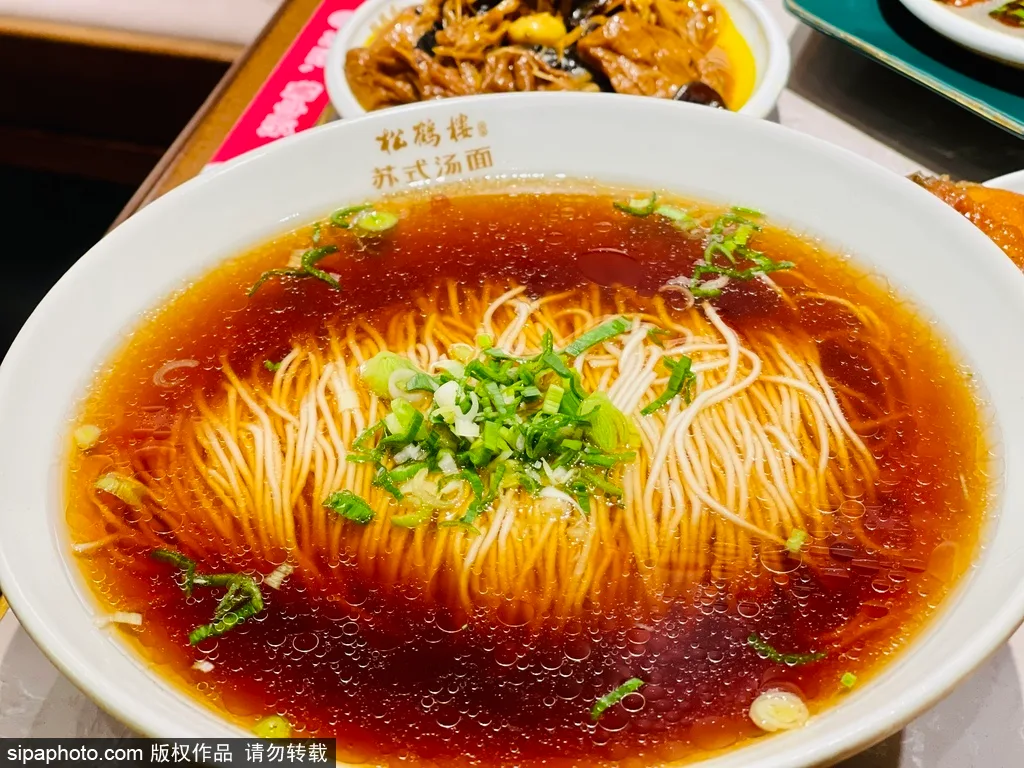
Suzhou-style noodle soup goes back a thousand years, first appearing in Tang and Song texts and settling into its modern technique in the Qing. It comes in two broths - red and white - both built on pork bone, chicken carcass and eel bone simmered slowly, and both aiming for a broth that is "clear but not greasy". The noodles themselves should show the classic form of "Guanyin's head, carp's back": slippery, springy, with bite. The toppings run into the hundreds - Suzhou noodle soup once set a world record with 518 varieties.
There is also a vocabulary. The first pot of broth in the morning gives you tou tang mian, "first-broth noodles". Extra spring onion is zhong qing, "heavy green". A topping served on the side rather than on the noodles is guo qiao, "over the bridge". And the standard of service in a good noodle shop is that the bowl waits for the customer, never the other way round.
Fengzhen noodles
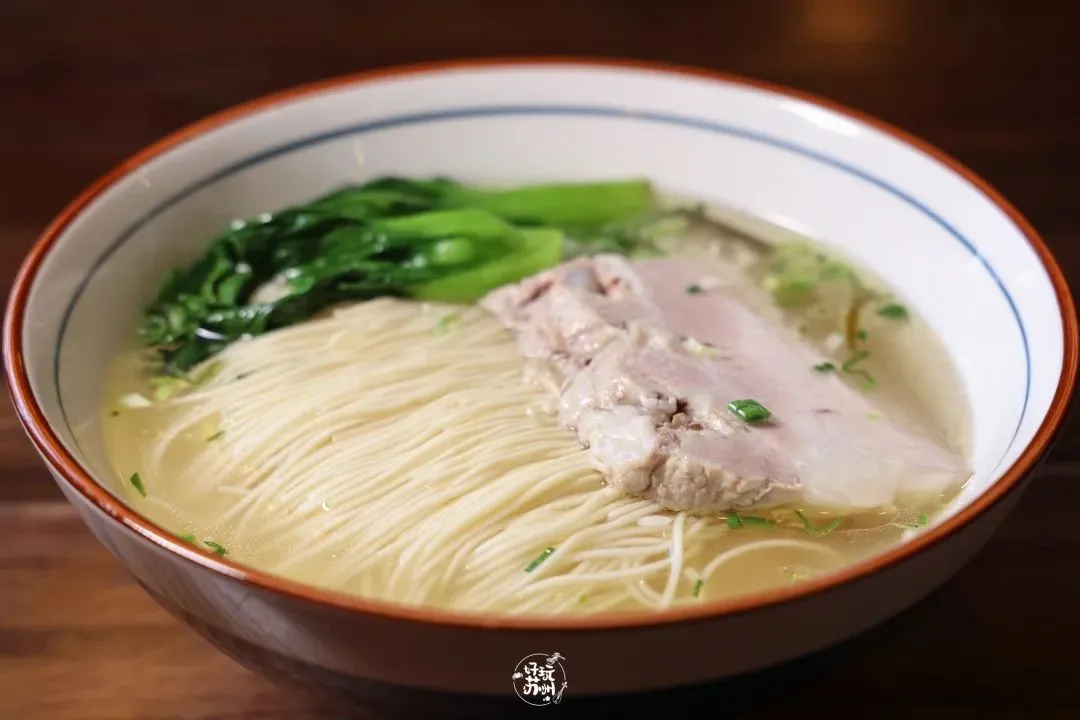
Fengzhen damian - also called Fengzhen white-broth pork noodles - comes from Fengqiao town in Suzhou. Its origin is told two ways: that the Qianlong emperor tasted and named it on a southern tour, or that it was created in the late Qing. It is a summer dish, became widely known through the second season of the documentary A Bite of China, was named one of Jiangsu's ten great noodle brands, and had its technique entered on Suzhou's intangible cultural heritage list in 2015.
The construction is unusual:
- The broth is white, made by a "blended broth" method that combines fermented-rice liquor, the braising liquid from the pork, and an eel-bone broth
- The topping is pork belly braised for hours until it falls apart without disintegrating, rich but not greasy
- The noodles are fine Suzhou silver-thread noodles - "thin and long, chewy and smooth" - arranged in the shape of a carp's back
Its flavour is summarised as three virtues: a fine broth, a careful topping, and springy noodles.
Tongdexing, founded in 1995, is a municipal-level heritage protection unit for the technique, with two core branches: Jiayufang (opened 2000) and Shiquan Street (November 2007). The Jiayufang branch entered the first Jiangsu edition of the Michelin Guide's Bib Gourmand for its seasonal specialities, and was listed again in 2025. What sets it apart is a menu designed around the four seasons; its summer-only Fengzhen pork noodles use white broth, white braised pork and grains of fermented rice, and appeared in A Bite of China. In 2023 the brand led the drafting of a local standard for Suzhou noodle technique, and in 2025 its training programme was recognised as a provincial cultural-tourism labour brand.
Sanxia noodles: two months a year
Sanxia mian uses shrimp roe, shrimp brain and shrimp meat together as the topping. The noodles are springy and smooth, the broth thick and savoury. The combination was first devised in Shanghai restaurants in the early 1920s and it remains an early-summer dish across the Jiangnan region, available only around the Dragon Boat Festival through June and July.
The labour is all in the picking: you need female river shrimp carrying roe, and each one has to be peeled for meat, shelled for brain and rubbed down for roe. The roe then goes into a soy sauce and the whole thing is fried with scallion oil, with the timing so tight that the shrimp stay crisp. Traditionally the topping is mixed into noodles already arranged as a carp's back; in some shops a waiter does the mixing at the table. Suyuzhai in Suzhou is a well-known representative, and appeared in the series Once Upon a Bite. Come in June, or not at all.
Pan-fried buns and pastries: the other half of the street
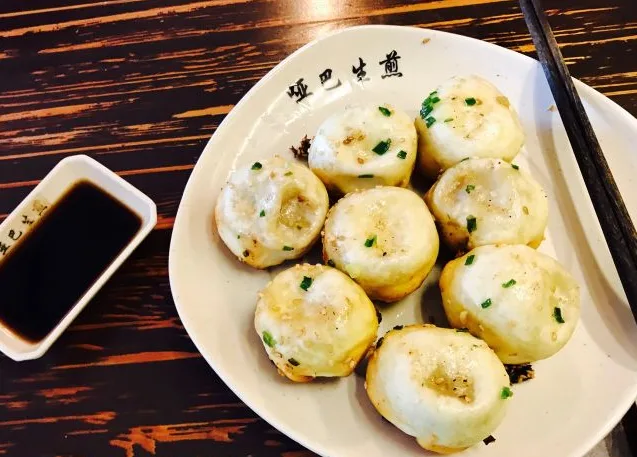
Yaba Shengjian takes its name from its founder, Yu Eryuan, who lost her speech as a child. She fell ill and became mute at nine, started learning pastry at thirteen - picking up the trick of setting aspic into the filling - and took over the family bun shop at sixteen, concentrating on technique. Her timing over the pan was precise, and a brand formed. It is now more than sixty years old, and the technique passed to the next generation in 2009.
The signature: a golden, crisp base, a thin skin, plenty of juice, and a filling with a sweet-savoury note. Branches include Lindun Road and Su'an Xincun in the Gusu district; the Lindun Road shop sits right beside Guanqian Street and queues daily. It opens 5:30am to 7:30pm and also serves noodles and wontons.
The form itself is old: pan-fried buns can be traced to miscellaneous fried buns recorded in the Northern Song text Wulin Jiushi. Suzhou's Wuyuan teahouse put them on the menu as a tea snack in 1911, after which they spread across the Jiangnan region; they reached Shanghai in the 1920s, where old houses like Luochunlou and Dahu Chun developed the two schools of "clear" and "mixed" buns. The method is part-pan-fry, part-steam: a golden crisp base, sesame and spring onion on top, and aspic in the filling - so mind the hot juice when you bite.
Huangtianyuan was founded in 1821 (the first year of the Daoguang reign). Its founder, Huang Qiting from Zhejiang, started with a zongzi stall at Duting Bridge on Dongzhongshi before taking a shopfront and moving into rice cakes and pastries under the name Huangtianyuan. In 1931 it opened a branch on Guanqian Street; the main shop at 86 Guanqian Street stands there today.
Suzhou pastries are an entire system: they emerged in the Spring and Autumn period, originated in Sui-Tang, took shape under the Song and expanded through the Ming and Qing. Wheat flour, nuts and pork lard are the base, with osmanthus and rose for aroma, giving the family its twin character - soft, glutinous cakes and flaky, crumbly biscuits. Seasonal items such as rice-wine cakes and mint cakes come and go through the year. At Huangtianyuan look for osmanthus sugar rice cake, five-colour cake, spring qingtuan, Double Ninth cake and eight-treasure rice. Its stir-fried pork noodles, developed from its stir-fried pork dumplings, was named one of the "ten bowls of Suzhou".
Zhuhongxing was founded in 1938 by Zhu Chunhong at Yuxing Bridge (today the corner of Renmin Road and Jiyou Lane). Its range and care earned it a reputation "famed from Beijing to Shanghai", and Lu Wenfu's novel The Gourmet mentions it repeatedly. The Ministry of Commerce named it a China Time-honoured Brand in its first batch in 2006; in 2014 it set up a master studio aimed at reviving lost noodle varieties. Its braised pork noodles and fried fish noodles are Suzhou classics, and the Guanqian branch sits in the middle of the action at Gong Lane and Bifengfang.
How to plan it
Noodles belong to breakfast and the afternoon. Get to an old noodle shop between 6 and 8am for first-broth noodles, when the broth is clearest. Keep lunch for a proper Suzhou meal, then come back to Yaba Shengjian or Huangtianyuan later. And check the calendar: sanxia noodles are June-July only, Fengzhen noodles are a summer dish.
Practical
- Vocabulary: extra spring onion = zhong qing; topping served separately = guo qiao; first broth of the day = tou tang mian
- Queues: Yaba Shengjian on Lindun Road queues daily; open 5:30am-7:30pm, quieter early
- Seasonality: sanxia noodles around Dragon Boat Festival to July; Fengzhen pork noodles in summer; rice-wine cakes, mint cakes and qingtuan come and go with the season
- Addresses: Huangtianyuan main shop, 86 Guanqian Street; Zhuhongxing Guanqian branch, Gong Lane at Bifengfang; Tongdexing Jiayufang branch
- Flavour note: the broth is deliberately "clear but not greasy" - if you like it heavier, ask for zhong qing or add a topping
Related
Photos
Sources
- Baidu Baike: Suzhou noodle soup, Fengzhen noodles, sanxia noodles, pan-fried buns, Suzhou pastries, Tongdexing, Yaba Shengjian
- Wikipedia: Zhuhongxing, Huangtianyuan