Xiekehuang and Pan-Fried Buns: Suzhou's Savoury Snacks
World Travel 编辑部 · 2026-09-10 · 10 min read
Xiekehuang and Pan-Fried Buns: Suzhou's Savoury Snacks
Ask anyone about Suzhou pastries and you will hear about sweetness — sticky rice cakes, sugar year cakes, osmanthus congee. But on the tea-shop counters and griddle stalls there is a second column, the savoury one: xiekehuang and fresh-pork pan-fried buns. One is flaky, one is crisp; one dry-fragrant, one bursting with juice. Together they are Suzhou's savoury half.
Xiekehuang: a bite of shell
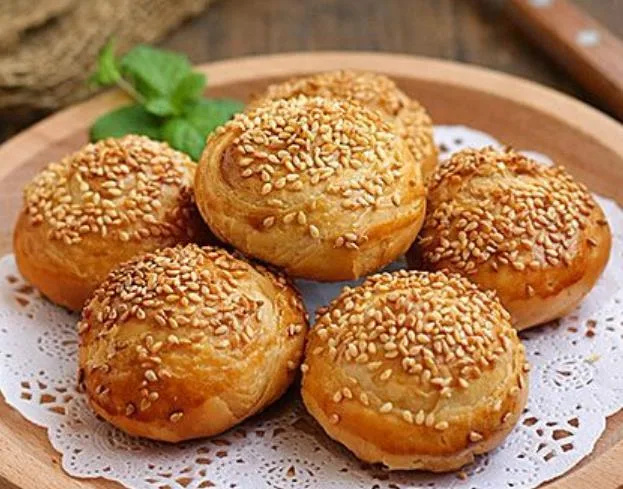
Xiekehuang ("crab-shell yellow") is one of the characteristic snacks of the Jiangsu-Zhejiang-Shanghai region, also found in Zhejiang, Shanghai and Anhui. It is a small, round baked flatbread, roasted until crisp, its surface golden or orange-yellow, like the shell of a cooked crab — hence the name. Locals also call it "little sesame cake".
Its fillings are commonly shepherd's purse, scallion oil, white sugar and lard bean paste. The character is summed up as: shell-shaped, golden, rich without being greasy, crisp and crumbly — sweet fillings mellow, savoury fillings fresh. The Shanghai style runs both sweet and savoury: sweet versions centre on sugar and lard, sometimes rose, date paste or bean paste; savoury versions centre on diced pork, and the more fastidious add crab roe or shrimp.
Mixing the dough is its own threshold. Besides water, oil goes in — and not a little of it — until the dough becomes "a shiny raw dough that will flake once baked". The sweet-savoury distinction does not live in the dough itself, but in a sweet-salty pastry paste of sugar or salt worked with a little flour and oil, wrapped into portions of dough, pressed into shape, showered with white sesame and stuck to the oven wall. Timing and heat are judged, and when the aroma comes out in waves, it is done.
There is a clock to it too: rarely in the morning, but from about three in the afternoon nearly every all-day griddle stall sells them hot. It works as a small snack, the pastry flaking in layers as you bite. Anhui's version, from Tunxi in Huangshan, belongs to Huizhou cooking and uses preserved greens with diced pork — another road entirely.
Fresh-pork pan-fried buns: crisp base, sweet juice
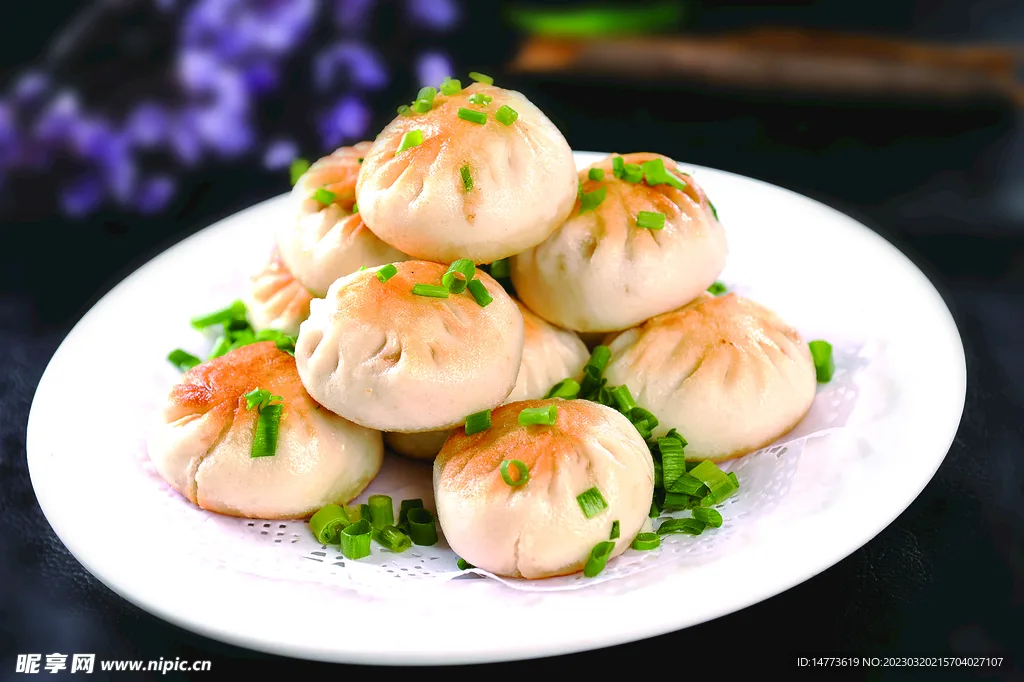
Shengjian mantou (pan-fried pork buns) are a traditional snack of Shanghai, Zhejiang, Jiangsu and Guangdong, made from flour, pork and sesame, and known for being crisp-skinned, juicy and meaty. Its history runs far back — traceable to the "assorted fried flower buns" recorded in the Song-dynasty Wulin Jiushi. Suzhou's Wuyuan teahouse put pan-fried buns on its tea menu in 1911, and only afterwards did they spread across the region; in the 1920s they reached Shanghai, where old houses such as Luochunlou and Dahu Chun developed the clear and mixed schools.
The method is half-fried, half-steamed: the base fried golden and crisp, the top scattered with sesame and scallion, the dough either half-leavened or fully leavened. The key is the filling — it contains pork-skin jelly, which melts into soup under heat, so bite carefully. Common fillings include fresh pork, shrimp and crab roe.
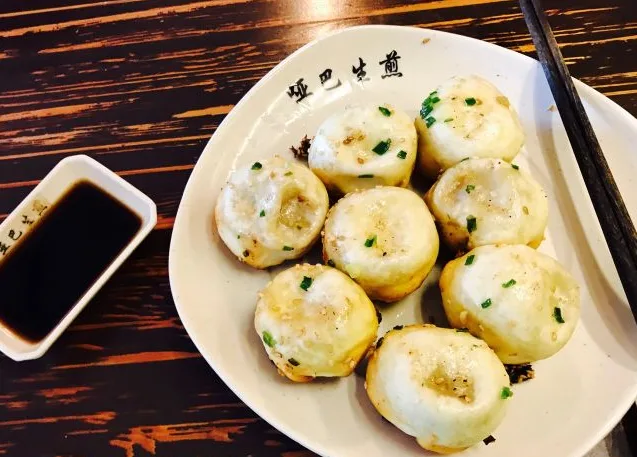
Suzhou's local benchmark is Yaba Shengjian, named for its founder Yu Eryuan, who lost her speech as a child. Mute from illness at nine, she began learning pastry at thirteen, mastering the pork-skin-jelly filling, and at sixteen took over the family bun shop and devoted herself to the griddle. The result: golden crisp base, thin skin, plenty of juice, sweet-savoury pork filling. Its Lindun Road branch sits beside Guanqian Street and queues daily. For the shop's story and queueing details, see Suzhou Noodles and Dim Sum.
Where the savoury sits in the Suzhou pastry canon
Suzhou pastry is a full system: it sprouted in the Spring and Autumn period, emerged in the Sui-Tang, took shape in the Song and expanded in the Ming and Qing. It uses wheat flour, nuts and diced pork fat, scented with osmanthus and rose, and its character is cakes tender and glutinous, biscuits flaky and loose, with tea snacks such as rice-wine cakes and mint cakes rolled out by season — across roast, fried, steamed and cooked-flour categories and more than 20 types, earning the name "southern pastry".
Within a system whose keynote is sweet and glutinous, xiekehuang and pan-fried buns represent the other side: savoury, flaky, with meat. They belong less to the formal tea-shop register and more to the street — but they have never been absent from daily Suzhou.
How to eat
- Xiekehuang: go after 3pm, buy them fresh from the griddle, and try one sweet and one savoury side by side
- Pan-fried buns: eat hot, but nibble a small opening first to let the steam out — the melted pork-skin jelly is scalding; a bowl of beef vermicelli soup or wonton alongside is the local way
- Pairing: one flaky, one crisp makes an ideal mid-walk refuel without spoiling a proper meal
Practical
- Availability: xiekehuang rarely in the morning, common after 3pm
- Fillings: pan-fried buns are most often fresh pork, with shrimp and crab roe variants; they contain pork-skin jelly, so hot but careful
- Local address: Yaba Shengjian, Lindun Road branch, beside Guanqian Street; open 5:30am-7:30pm, quieter early
- Flavour note: Suzhou savoury snacks carry a touch of sweet-savoury glaze; taste a little first if you prefer strictly salty
Related
- Suzhou Noodles and Dim Sum: The Craft Behind a Bowl
- Guanqian Street and Taijian Long: The Old Guard of Suzhou Cuisine
Photos
Sources
- Wikipedia: xiekehuang, shengjian mantou
- Baidu Baike: shengjian mantou, Yaba Shengjian, Suzhou pastries