The Terracotta Army: Reading the Underground Legions of Qin
World Travel 编辑部 · 2026-09-16 · 7 min read
On 29 March 1974, during a drought in Lintong, a villager named Yang Zhifa struck fragments of pottery while digging a well. Locals called the figures "clay grandfathers". No one yet knew that the spade had uncovered an army buried east of the First Emperor's tomb for more than two thousand years.
Three pits, three formations
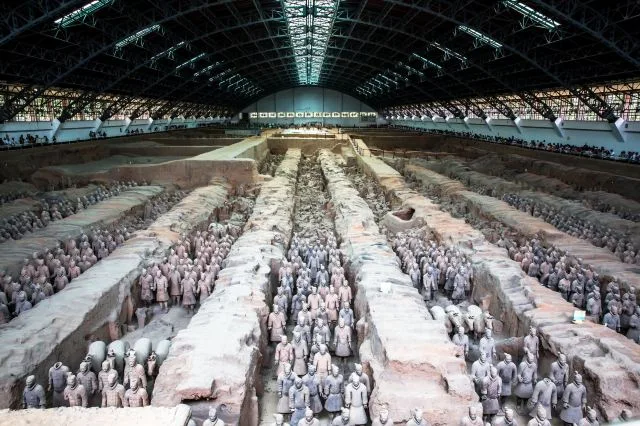
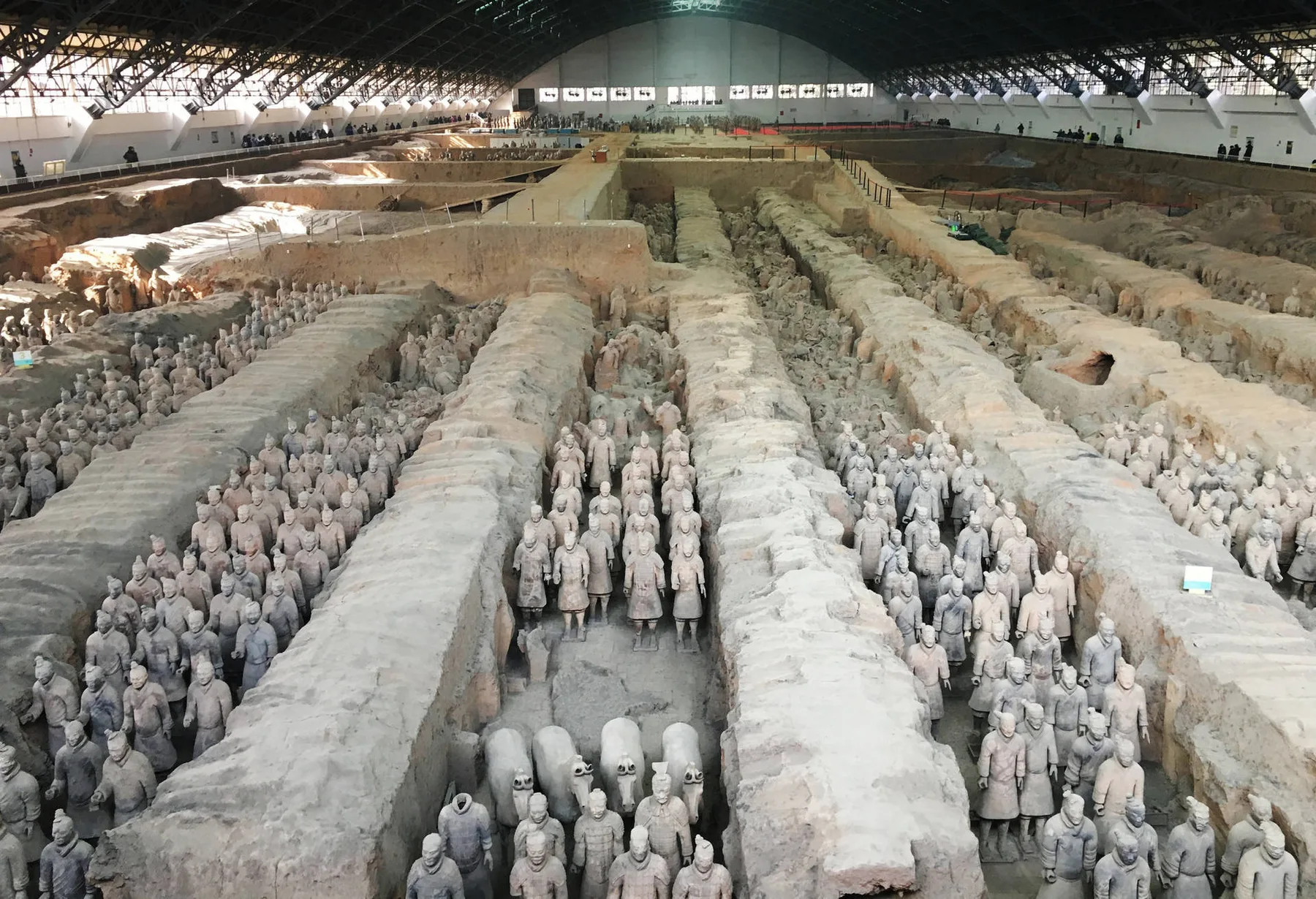
The Terracotta Army is a group of pottery soldiers from large burial pits east of Qin Shi Huang's mausoleum, in Lintong District of Xi'an. Three main pits are confirmed: Pit 1, Pit 2 and Pit 3, each arranged as a different formation of soldiers, chariots and horses, with bronze weapons and other grave goods. Pit 1 is the largest, Pit 2 has the widest mix of arms, and Pit 3 is generally read as the army's command post.
Between 1976 and 1978 the excavation team added archaeologists, conservators and photographers, and work proceeded on all fronts. On 1 October 1979 the museum opened to visitors at home and abroad.
Not made from a single mould
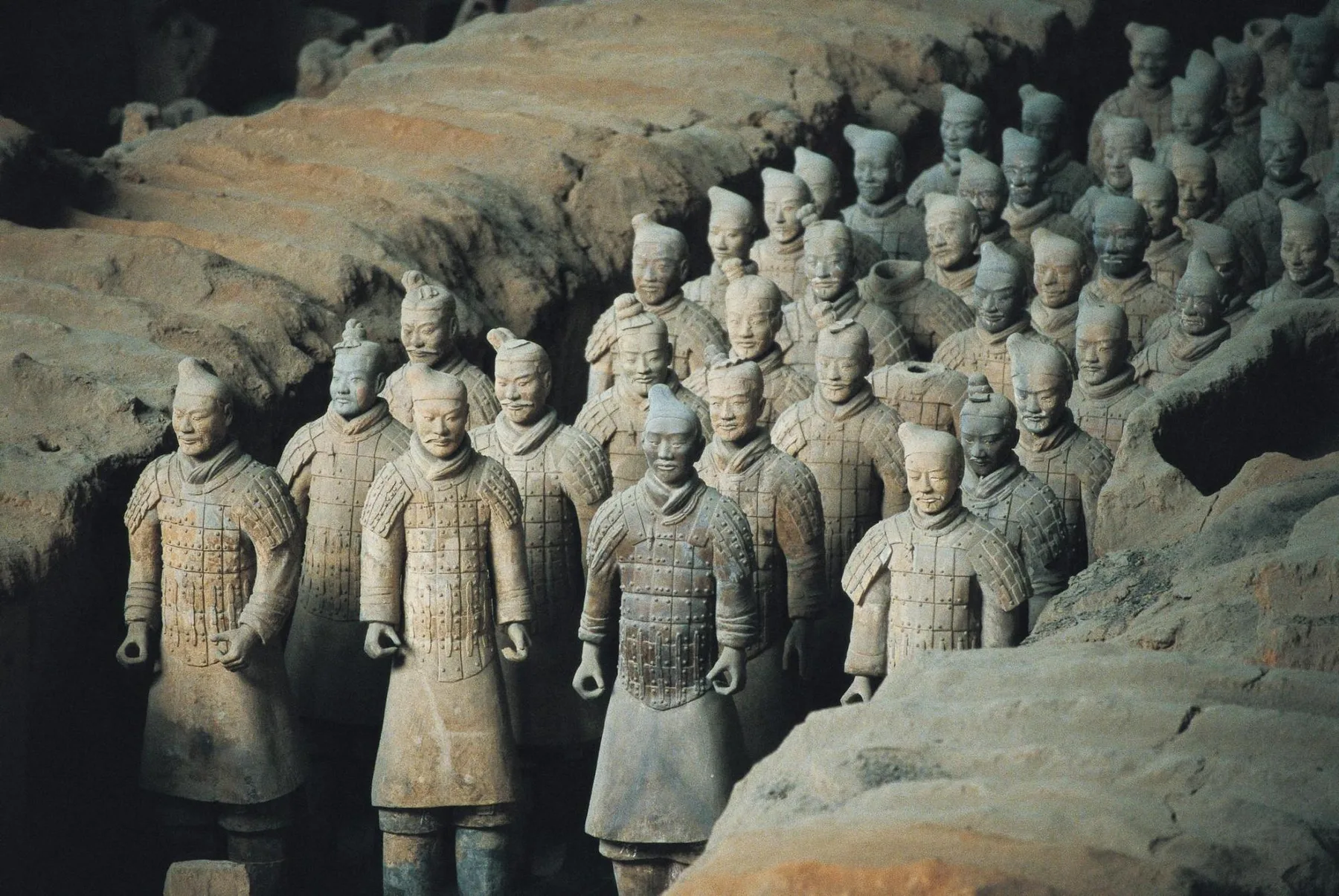
The figures are close to life size, and their dress, hair, posture and equipment vary with rank and arm — which is what makes them worth looking at closely. Take the standing archer: excavated from the east of Pit 2, he carries a crossbow and forms a crossbow formation with the kneeling archer. He stands at the front of the array in a light robe, hair bound in a topknot, a leather belt at the waist and square-toed, upturned shoes.
The Methods of Wu and Yue describes archery as "left foot forward, right foot across, left hand like holding a branch, right hand like cradling a child" — precisely the standing archer's pose. Within one army, the left chariot warrior, the right chariot warrior and the officer each wear and do something different: the left warrior grips a spear, dagger-axe, blade or halberd while his right hand rests on the chariot; officers rank above one another and carry command.
A burial pit, not a tomb
A common misunderstanding treats the Terracotta Army as the tomb itself. In fact it is no separate mausoleum but one of many burial installations in the First Emperor's necropolis, and among the pits found so far only one of several. The pits go unmentioned in historical records, which is why the figures survived two millennia largely intact.
In 1987 the mausoleum and its pits were inscribed on the World Heritage List under the name of the Mausoleum of the First Qin Emperor. Emperor Qinshihuang's Mausoleum Site Museum now displays the excavation sites of Pits 1 to 3 and the figures recovered, while the unexcavated areas remain objects of archaeology and conservation.
What you actually see today
Most figures now read as plain clay. Yet accounts say the colours of dress and weapon were vivid when first seen, fading within minutes of exposure to air. So rather than hunting for colour, look at how the formation is laid out and at the detail on individual figures.
Practical Notes
- Pit 3 is small and looks empty; it is the command post. Read the panels before the pit and it makes sense.
- Pit 1 is the busiest hall — go at opening and see it first, then Pits 2 and 3.
- The army sits in Lintong on the same side as the mausoleum and Huaqing Palace, so the three fit into one day.
Related
- The Mausoleum of Qin Shi Huang: The Tomb That Has Never Been Opened
- Huaqing Palace: The Imperial Hot Springs Below Mount Li
- Xi'an City Wall Half-Day Guide: From Yongning Gate to Hanguang Gate
Photos
Sources
- Wikipedia: Terracotta Army
- Wikipedia: Mausoleum of the First Qin Emperor