Yangling: The Tomb Complex of Emperor Jing and Empress Wang
World Travel 编辑部 · 2026-09-16 · 6 min read
In the first month of 153 BCE work began on Yangling, and in the fifth month settlers were recruited to move to Yangling Township with a grant of 200,000 cash each. Emperor Jing died in 141 BCE and was buried ten days later; fifteen years on, Empress Wang was interred with him. From first works to final burial, the tomb took 28 years.
Emperor and empress in one cemetery
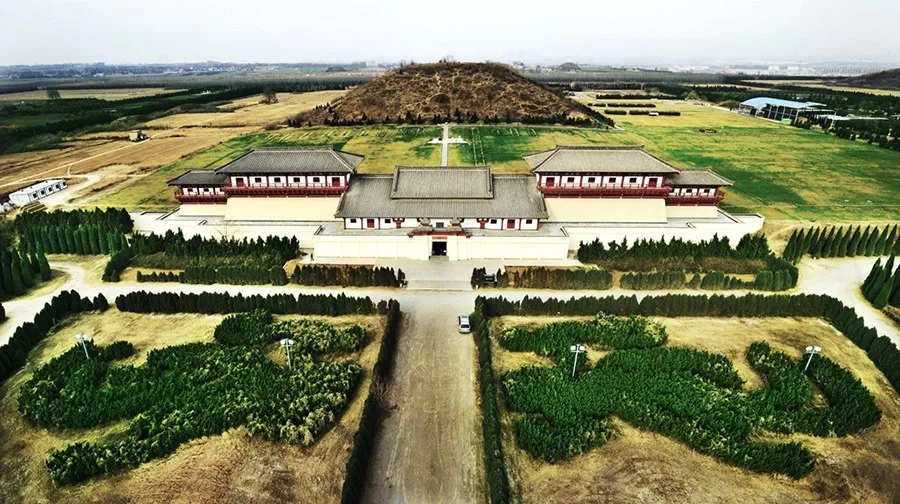
Yangling is the joint burial complex of Emperor Jing of the Western Han, Liu Qi, and his empress Wang — one cemetery, separate chambers. It lies on the Xianyang plateau in Weicheng District, Xianyang, at the east end of the Western Han imperial tombs there, straddling Weicheng, Jingyang County and Gaoling County.
The cemetery sits between the Jing and Wei rivers, which meet just to its east. It comprises the emperor's tomb precinct, the empress's precinct, southern and northern burial-pit zones, ritual buildings, attendant tombs, the graves of convict labourers and Yangling Township itself.
Tumulus and pits
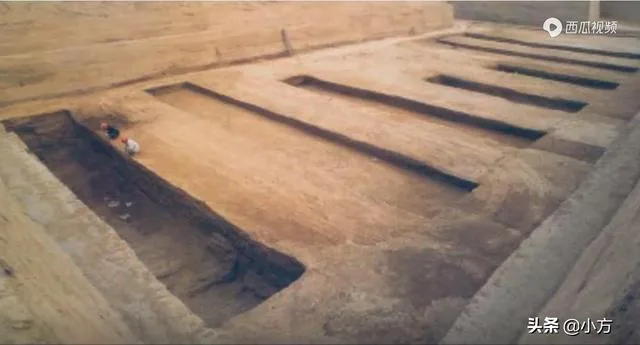
The emperor's tomb is the core, with Emperor Jing below. Its mound rises about 31 m, with 81 burial pits radiating around it; the south gate-tower was the main entrance and was larger than the rest, and has now been excavated and conserved. The empress's tomb lies 450 m east, about 25.5 m high, with 28 pits and Empress Wang below.
The southern and northern pit zones lie 450 m northwest and southeast of the emperor's tomb, 24 pits each, of varying length and width — the longest 299 m. Because most of what they yielded is military, archaeologists read them as a miniature of the Western Han southern and northern armies.
Seeing it today
In 1956 Yangling was listed in the first batch of Shaanxi protected sites, and in 2001, as one of the Western Han imperial tombs, in the fifth batch of nationally protected sites. A museum has been built on site for conservation and visiting.
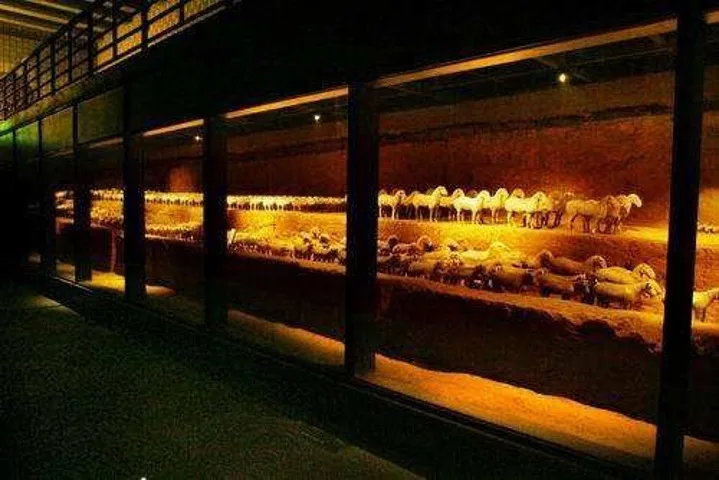
What is most worth seeing at Yangling is the underground side: through the glass corridors of the underground museum you can see the burial pits close up in situ — a view no other imperial tomb offers.
Practical Notes
- It lies in Xianyang, some distance from central Xi'an, so give it its own half-day.
- The underground museum is the highlight — see it before the surface precincts.
- Though also Han, it is far from Weiyang Palace; do not schedule them as one route.
Related
- Weiyang Palace: The Great Audience Hall of Han Chang'an
- The Mausoleum of Qin Shi Huang: The Tomb That Has Never Been Opened
- The Terracotta Army: Reading the Underground Legions of Qin
Photos
Sources
- Wikipedia: Yangling Mausoleum